Shopify real cost by revenue: which plan is actually cheapest?
See the real monthly cost of Shopify: plans, card & transaction fees, apps, themes and POS. Model Basic vs Grow vs Advanced vs Plus at your sales volume.
You do not feel Shopify’s cost in the $29–$299 plan price. You feel it in card fees, apps and POS. Once a store is doing real revenue, the true monthly cost is usually 3–10x the subscription, and is driven far more by payment fees and your app stack than by which core plan you choose.
Quick verdict
For most stores, the Shopify subscription is the smallest line on the bill. On Basic at $29/month (yearly), a realistic small-store cost is closer to $130/month once you add card fees and a few apps. At mid volume, a Grow store at $79/month can easily run near $950/month all-in, and a serious Advanced store at $299/month can see over $4,000/month in total Shopify-related cost.
The decision rule: model your total cost of ownership (plan + card and transaction fees + apps + theme + POS/marketplace extras) at your expected revenue. Below roughly $5k/month in sales, Basic with a free theme and 1–3 apps is usually cheapest. Above roughly $10k–$20k/month, the lower card and transaction fees on Grow or Advanced often save more than the higher subscription. Apps and third‑party gateways can quietly cost more than an upgrade, especially in regions where cash on delivery and local gateways matter, like the GCC where Salla competes directly with Shopify.
Shopify plans, card fees and transaction fees at a glance
Shopify’s US pricing page highlights four core online‑store plans for full ecommerce sites—Basic, Grow, Advanced and Plus—each with a different subscription price and Shopify Payments card rate, and Shopify’s docs show a matching third‑party transaction fee tier by plan on the official pricing page.
 Shopify’s official US pricing table showing how subscription prices, card rates, and third‑party transaction fees vary between Basic, Grow, Advanced, and Plus, which underpins the cost models in this article.
| Plan |
Yearly price (US) |
Monthly price (US) |
Standard online card rate (Shopify Payments) |
Additional fee with third‑party payment provider |
POS Pro |
| Basic |
$29/month (billed yearly) |
$39/month |
2.9% + $0.30 |
2% per transaction |
$89/month per location add‑on |
| Grow |
$79/month (billed yearly) |
$105/month |
2.7% + $0.30 |
1% per transaction |
$89/month per location add‑on |
| Advanced |
$299/month (billed yearly) |
$399/month |
2.5% + $0.30 |
0.6% per transaction |
$89/month per location add‑on |
| Plus |
From $2,300/month on a 3‑year term (contract) |
2.25% + $0.30 (standard online card rate) |
0.2% per transaction when using a third‑party payment provider |
Includes up to 200 POS Pro locations when you use Shopify Payments |
According to Shopify’s pricing FAQ and the Shopify Payments fees help page, there are no setup fees on any plans and no additional monthly fee for Shopify Payments beyond the listed card rates. Third‑party transaction fees apply only when you use an external payment provider instead of Shopify Payments as explained in Shopify’s fees help.
Decision table: which plan is cheapest by scenario?
| Option |
Best for |
Starting price (yearly) |
Main strength |
Main limitation |
| Basic |
Solo or side‑hustle stores under ≈$5k/month revenue |
$29/month |
Lowest fixed cost; full online store |
Highest card and third‑party transaction fees |
| Grow |
Small teams doing ≈$10k–$50k/month |
$79/month |
Lower card/transaction fees; more staff accounts |
Calculated shipping still an add‑on |
| Advanced |
Scaling brands ≈$50k–$500k/month |
$299/month |
Even lower fees; advanced reports; shipping rates included |
Big jump in subscription vs Grow |
| Plus |
High‑volume or complex businesses |
From $2,300/month |
Lowest card/transaction fees; enterprise checkout; many POS locations included |
Contract and cost only justify at scale |
The cost components you must model (not just the plan)
Based on Shopify’s pricing tables and independent cost breakdowns of real stores that analyse total cost of ownership, a realistic monthly cost model needs to include:
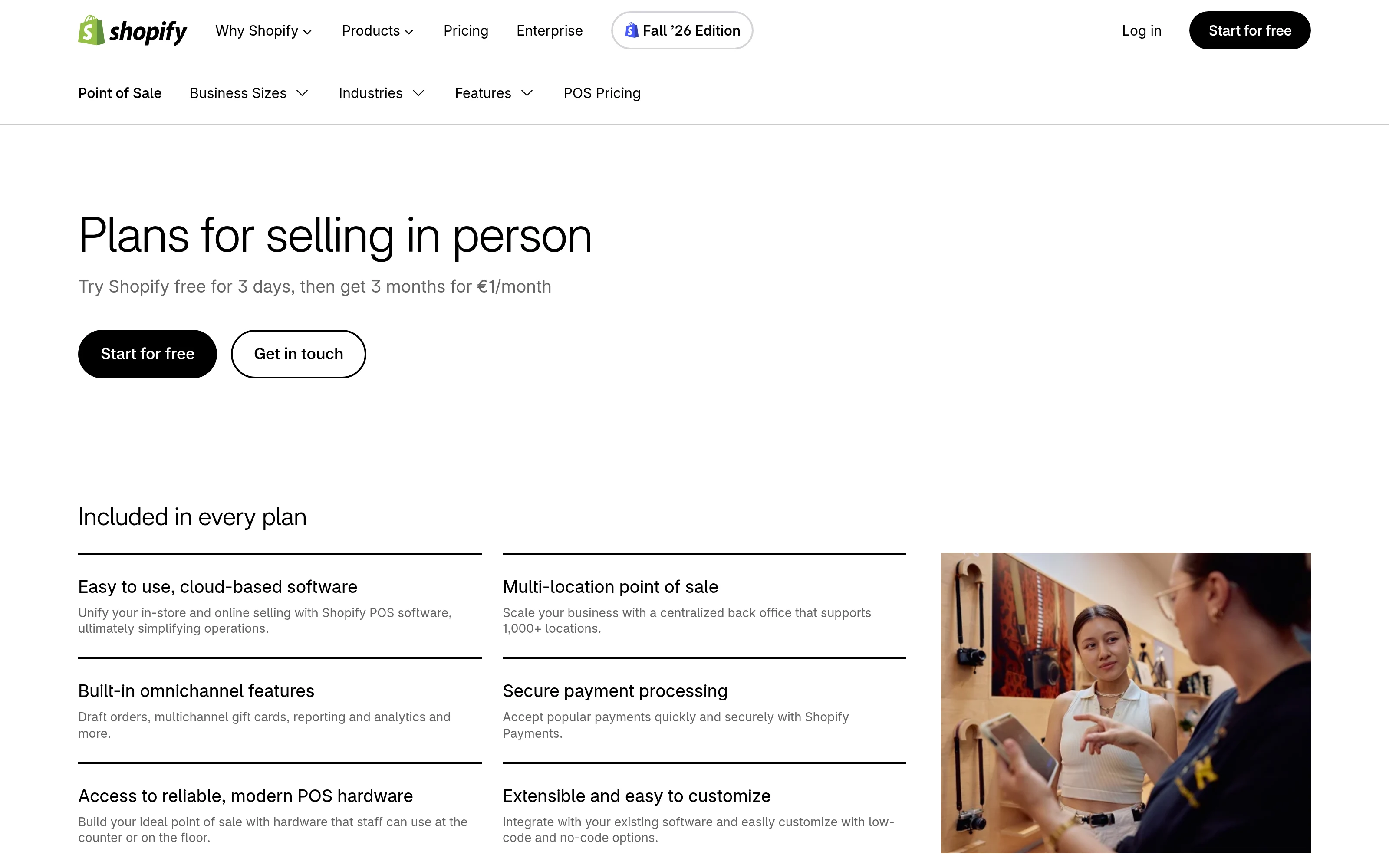 Shopify’s POS pricing page confirming POS Pro as a separate $89 per‑location cost on standard plans and its bundled inclusions on Plus, supporting the article’s treatment of POS as a distinct cost driver.
 Shopify’s own shipping carrier page stating US merchants can save up to 88% off USPS retail rates when buying labels through Shopify, illustrating how discounted shipping partly offsets total Shopify costs.
- Plan subscription – fixed monthly or yearly fee.
- Payment processing – Shopify Payments card rates or your gateway + Shopify’s third‑party transaction fee tier.
- Apps – recurring SaaS from the Shopify App Store.
- Theme – free or a one‑time paid theme, amortised.
- POS – POS Lite (included) vs POS Pro add‑on for in‑person retail.
- Operational extras – marketplace order sync charges, calculated shipping add‑ons.
Analyses of Shopify fees per sale in 2026 consistently show that for most US stores using Shopify Payments, effective per‑sale costs are dominated by card rates in the 2.9%–2.25% + $0.30 range as one detailed fees calculator explains. The subscription is often a minority of total cost once apps, themes and these per‑sale fees are factored in.
Real monthly cost scenarios: three store sizes
The scenarios below use only public Shopify prices in USD and conservative app/theme assumptions from Theme Store and App Store analyses. They exclude VAT/sales tax and shipping label postage.
Scenario 1: solo starter on Basic – low volume, free theme, minimal apps
Profile: New solo merchant, Basic plan on yearly billing, using Shopify Payments, no POS Pro, selling mainly domestically online. If you are in the UAE or wider GCC, you will also want to budget separately for your trade licence and local payment setup, which I cover in more detail in how to start a Shopify store in the UAE the right way.
Inputs (from the brief’s model and Shopify pricing):
- Plan: Basic yearly at $29/month.
- Revenue: $2,000/month.
- Orders: 50 per month (average order value $40).
- Card fees (Shopify Payments, US): 2.9% + $0.30 per transaction as per pricing table.
- Apps: 3 paid apps on entry tiers around $9.99/month.
- Theme: free (0 cost).
- Marketplace sync: below 50 marketplace orders, so free tier.
Step‑by‑step cost:
- Subscription: $29/month.
- Card fees: 2.9% of $2,000 = $58.00; $0.30 × 50 orders = $15.00 → $73/month.
- Apps: ≈$10 × 3 = $30/month (within the $9.99–$24.99 median entry range reported by app pricing studies such as Appanalizer’s).
- Theme: $0.
- Marketplace sync: $0 (within free 50‑order allowance noted on the Marketplace Connect listing).
Estimated real monthly cost:
$29 (plan) + $73 (card fees) + $30 (apps) = $132/month.
Cost structure:
- Plan ≈ 22% of total.
- Card fees ≈ 55%.
- Apps ≈ 23%.
Decision implication: at this volume, there is no financial case for upgrading purely for lower card rates. The priority is keeping apps light and sticking to a free theme. Paid themes or heavy apps would dominate costs.
Scenario 2: growing DTC brand on Grow – mid volume, one paid theme, mid‑range apps
Profile: Small team, Grow plan on yearly billing, one retail showroom using POS Pro, paid theme, several growth and operations apps, using Shopify Payments.
Inputs:
- Plan: Grow yearly at $79/month.
- Revenue: $20,000/month.
- Orders: 400 per month (average order value $50).
- Card fees: 2.7% + $0.30 on Grow per pricing table.
- Theme: paid theme at $320 one‑time, amortised over 36 months.
- Apps: 6 paid apps (4 ≈$10/month, 2 ≈$25/month).
- POS Pro: 1 location at $89/month as per POS pricing.
- Marketplace sync: modest activity above 50 orders, budget 1% fee buffer up to $20/month.
Step‑by‑step cost:
- Subscription: $79/month.
- Card fees: 2.7% of $20,000 = $540; $0.30 × 400 orders = $120 → $660/month.
- Theme: $320 ÷ 36 ≈ $8.89 → ≈$9/month.
- Apps: (4 × $10) + (2 × $25) = $40 + $50 = $90/month, consistent with the $9.99–$24.99 median range highlighted in app price studies such as Bestappify’s 500‑listing analysis.
- POS Pro: $89/month for one Pro location on a non‑Plus plan confirmed on the main pricing page.
- Marketplace sync: ≈$20/month buffer towards the 1% fee capped at $99/month for more than 50 marketplace orders, as described on the Marketplace Connect app listing.
Estimated real monthly cost:
$79 (plan) + $660 (card fees) + $9 (theme amortised) + $90 (apps) + $89 (POS Pro) + $20 (marketplace buffer) ≈ $947/month.
Cost structure:
- Plan ≈ 8% of total.
- Card fees ≈ 70%.
- Apps + theme ≈ 11%.
- POS Pro + marketplace extras ≈ 11%.
Decision implication: at this revenue, the choice between Basic and Grow should be driven mainly by card/transaction fee savings, not the plan headline price. As shown below, the lower 2.7% card rate versus 2.9% can already cover much of the extra subscription at this scale.
Scenario 3: scaling omni‑channel retailer on Advanced – high volume, heavier apps, POS Pro
Profile: Established brand, Advanced plan on yearly billing, multiple physical stores on POS Pro, premium paid theme, heavier app stack including some higher‑tier tools, using Shopify Payments exclusively. If your footprint starts to look like this, you are also in the territory where Shopify vs local-first platforms and gateways is a real question; for example, some Gulf retailers benchmark Advanced and Plus against Salla’s real plan costs and local PSPs like Tabby or Tamara.
Inputs:
- Plan: Advanced yearly at $299/month.
- Revenue: $100,000/month.
- Orders: 2,000 per month (average order value $50).
- Card fees: 2.5% + $0.30 on Advanced per pricing table.
- Theme: premium theme at $380 one‑time, amortised over 36 months.
- Apps: 10 paid apps; 6 at ≈$15/month and 4 at ≈$40/month, reflecting a mix of median‑priced tools and some higher tiers.
- POS Pro: 3 locations at $89/month each.
- Marketplace sync: assume hitting the $99/month cap from the Marketplace Connect pricing.
Step‑by‑step cost:
- Subscription: $299/month.
- Card fees: 2.5% of $100,000 = $2,500; $0.30 × 2,000 = $600 → $3,100/month.
- Theme: $380 ÷ 36 ≈ $10.56 → ≈$11/month.
- Apps: (6 × $15) + (4 × $40) = $90 + $160 = $250/month. (The brief’s example used $290/month; either figure sits comfortably within independent findings that median plan prices are around $24.99 with a long tail at $100+/month.)
- POS Pro: 3 × $89 = $267/month.
- Marketplace sync: $99/month fee cap on 1% of synced marketplace orders, as listed in Marketplace Connect’s pricing.
Estimated real monthly cost (using the brief’s slightly higher app assumption for consistency):
$299 (plan) + $3,100 (card fees) + $11 (theme amortised) + $290 (apps) + $267 (POS Pro) + $99 (marketplace) ≈ $4,066/month.
Cost structure:
- Plan ≈ 7% of total.
- Card fees ≈ 76%.
- Apps + theme ≈ 7%.
- POS Pro + marketplace ≈ 10%.
Decision implication: at this scale, moving from Grow to Advanced or even Plus is mostly a question of payment fees and POS locations, not store features. A small change in card percentage on six‑figure monthly revenue dwarfs the subscription difference.
How to choose the cheapest plan at your revenue level
This section normalises the arithmetic so you can plug in your own numbers.
1. Understand how much you really pay in card fees
With Shopify Payments in the US, the standard online card rates by plan are explicitly listed as:
- Basic: 2.9% + $0.30.
- Grow: 2.7% + $0.30.
- Advanced: 2.5% + $0.30.
- Plus: 2.25% + $0.30.
There are higher “online premium card rates” and an extra +1% for international cards, but the calculations above use standard domestic cards only, as stated in the brief’s assumptions.
Example: when does Grow card saving beat the higher subscription?
- Difference in percentage fee between Basic and Grow: 2.9% – 2.7% = 0.2 percentage points.
- On revenue R, percentage fee saving = 0.2% × R = 0.002 × R.
- Extra subscription cost (yearly billing): Grow $79 – Basic $29 = $50/month.
Set savings = extra subscription: 0.002 × R = 50 → R = 50 ÷ 0.002 = $25,000/month.
So, ignoring the per‑transaction $0.30 (which is the same) and third‑party fees, the raw percentage card saving on Grow fully covers the extra $50/month in subscription at around $25,000/month in card volume.
At smaller volumes, Grow may still make sense if more staff accounts or features are needed, but purely on card % it is neutral around $25k/month.
Example: when does Advanced beat Grow on card fees?
- Difference between Grow and Advanced: 2.7% – 2.5% = 0.2 percentage points.
- Extra subscription cost (yearly): Advanced $299 – Grow $79 = $220/month.
- 0.002 × R = 220 → R = 220 ÷ 0.002 = $110,000/month.
So the raw percentage card saving moving from Grow to Advanced breaks even around $110k/month in online card revenue, again excluding any benefit from features and ignoring per‑transaction or international surcharges.
2. Add Shopify’s third‑party transaction fees if you do not use Shopify Payments
If Shopify Payments is not available in a country or a third‑party provider is chosen, Shopify adds an extra fee on top of the gateway’s own fees. The pricing information in Shopify’s docs gives these percentages as:
- Basic: 2%.
- Grow: 1%.
- Advanced: 0.6%.
- Plus: 0.2%.
The Shopify Help Center explains that these are calculated on each sale and collected via the Shopify bill, and that if Shopify Payments is not available, they are proportionally credited back on refunds as detailed in the third‑party transaction fees documentation.
Example: cost of Shopify’s extra fee at $20,000/month via a third‑party gateway
- Basic: 2% × $20,000 = $400/month.
- Grow: 1% × $20,000 = $200/month.
- Advanced: 0.6% × $20,000 = $120/month.
- Plus: 0.2% × $20,000 = $40/month.
Ignoring the gateway’s own percentage, just Shopify’s extra fee is already several times the plan price difference at this revenue:
- Basic vs Grow: $400 – $200 = $200/month more on Basic.
- Grow vs Advanced: $200 – $120 = $80/month more on Grow.
For a merchant forced to use a third‑party gateway, staying on Basic beyond a few thousand dollars in revenue can be more expensive than upgrading, purely because of Shopify’s extra fee layer.
3. Factor in paid apps realistically
Shopify’s own Shopify vs Wix comparison page states that the Shopify App Store has more than 21,000 apps, citing an internal count as of December 31, 2025, and independent analyses of pricing across hundreds of those listings show that:
- Median entry prices for paid apps cluster around $9.99/month, with category variation as Appanalizer reports.
- Across 500 app listings, the median monthly plan price across tiers was $24.99 and the mean $74.15, with about 12.9% of tiers at $100/month or more according to Bestappify’s sampling.
A basic but practical budget rule:
- Lean stack (1–3 apps): budget $10–$75/month.
- Typical growing store (4–8 apps): budget $60–$250/month.
- Heavier stack (10+ apps, including 1–2 at $100+): budget $300–$700+/month.
If app choices are not controlled carefully, 2–3 apps at $100/month each can cost more than moving from Basic to Advanced.
4. Amortise theme cost over a realistic lifetime
Shopify’s Theme Store has a significant number of free options and a large catalogue of paid themes. One third‑party census of Theme Store listings reports 24 free official themes as of 2026, based on an October 2026 scrape of Shopify’s Theme Store filters according to Commerce Quarterly’s index. Several analyses of paid themes report:
Spread over 3 years (36 months), typical monthly equivalents are:
- $100 theme → ≈$2.78/month.
- $320 theme → ≈$8.89/month.
- $380 theme → ≈$10.56/month.
- $500 theme → ≈$13.89/month.
This shows why, for most small and mid‑size stores, a good paid theme is cheaper than commissioning a custom build. Its amortised cost is usually less than even one mid‑tier app.
5. Include POS Pro and marketplace sync if you need them
For in‑person retail, Shopify bundles POS Lite with every plan, but charges extra for POS Pro. The main pricing table and dedicated POS pricing page both state that POS Pro is $89/month per location on Basic, Grow and Advanced billed yearly as an add‑on. Plus includes up to 200 POS Pro locations at no extra Pro fee when you use Shopify Payments, according to the current US pricing comparison table.
If multiple physical shops are operated, POS Pro can easily become a large share of Shopify spend:
- 1 store: $89/month.
- 3 stores: $267/month.
- 10 stores: $890/month.
For serious omni‑channel retailers, this is one reason Shopify Plus can become cheaper overall, since Plus bundles many POS Pro locations within the $2,300+ base fee.
For marketplace sync, Shopify’s Marketplace Connect sales channel app lists the first 50 synced marketplace orders per month as free, and charges 1% of additional synced orders up to a cap of $99/month. If marketplaces are a major channel, expect to hit that cap and treat $99/month as a fixed cost.
Basic vs Grow vs Advanced vs Plus: when to switch
Using the scenarios and fee arithmetic above, simple thresholds can be applied.
Stay on Basic when you are under about $5,000/month and lean on free tools
If online revenue is under roughly $5,000/month and it is possible to:
- Use a free theme.
- Keep the app stack to 1–3 lightweight apps around $10/month each.
- Avoid heavy POS Pro usage or advanced shipping add‑ons.
…then Basic yearly at $29/month is usually the cheapest option. The net fee difference to Grow is minor at low volume, and the extra $50/month in subscription on Grow is unlikely to be covered by card savings alone.
Upgrade to Grow or Advanced once you are consistently beyond ≈$10k–$20k/month on Shopify Payments
Once monthly revenue grows into the $10k–$20k+ range, card and transaction fees start to dominate. Using the break‑even maths earlier:
- On Shopify Payments, Grow’s lower card rate is clearly beneficial as revenue approaches $25k/month, especially if extra staff accounts and moderate features are valuable.
- Advanced’s lower rate makes pure card savings justify the upgrade around $110k/month, though some merchants may switch earlier for advanced reports and included calculated shipping.
For a store on Basic at $20k/month with Shopify Payments, card fees are roughly:
- Basic: 2.9% × $20,000 = $580 plus per‑transaction fees.
- Grow: 2.7% × $20,000 = $540 plus per‑transaction fees.
That 0.2% difference is $40/month, which is slightly below the $50 extra subscription for Grow on yearly billing. So purely on card percentage, this is near break‑even and operational features should also be weighed.
If you must use a third‑party gateway, model Shopify’s extra fee carefully
When Shopify Payments is unavailable or unsuitable, Shopify’s additional 2%/1%/0.6%/0.2% fee becomes a major driver. As shown in the $20k/month example:
- Staying on Basic can cost an extra $200/month versus Grow solely in this fee layer.
- The decision to upgrade can be justified at lower revenue, because the savings in Shopify’s fee tier alone can outstrip the plan price difference.
The Shopify Help Center notes that third‑party transaction fee rates vary by plan and directs merchants to the pricing page for their specific rate in the third‑party providers guide. That rate, multiplied by card volume, should be central in plan choice if Shopify Payments is not used.
Consider Plus when card volume and POS locations are very high
Shopify Plus starts at $2,300/month on multi‑year contracts according to the US pricing page. It drops standard card rates to 2.25% + $0.30, reduces the third‑party transaction fee to 0.2%, and includes up to 200 POS Pro locations when using Shopify Payments.
Pure card fee break‑even between Advanced and Plus:
- Percentage difference: 2.5% (Advanced) – 2.25% (Plus) = 0.25 percentage points.
- Extra subscription: assume Plus at $2,300 – Advanced at $299 = $2,001/month.
- 0.0025 × R = 2,001 → R ≈ $800,400/month in card revenue.
That is a rough break‑even on percentage card fees alone. In practice, many Plus merchants switch earlier for other reasons: complex requirements, the value of included POS Pro locations for many stores, advanced checkout customisation and multi‑store features.
Building your own Shopify real cost calculator
The logic of this article can be recreated in a simple spreadsheet.
Step 1: Input your assumptions
- Plan: Basic/Grow/Advanced/Plus.
- Billing: monthly or yearly (for the correct subscription price).
- Monthly online revenue (domestic) and number of orders.
- Whether Shopify Payments is used.
- Number of paid apps and typical price tier for each (e.g. 3 × $10, 2 × $25, 1 × $100).
- One‑time theme cost and expected lifetime (e.g. $320 over 36 months).
- Number of POS Pro locations.
- Monthly synced marketplace orders.
Step 2: Calculate monthly subscription cost
Use Shopify’s list prices for the chosen plan and billing frequency:
- Basic yearly: $29/month.
- Grow yearly: $79/month.
- Advanced yearly: $299/month.
- Plus base: $2,300/month (approximate, contract‑dependent).
Step 3: Calculate Shopify Payments card fees
For domestic standard cards, use:
- Card fee = (card rate %) × revenue + $0.30 × orders.
Where card rate % is 2.9%, 2.7%, 2.5% or 2.25% by plan. Adjust with +1% if a large share of volume is international, as the pricing table notes “Online international rates +1%” across plans.
Step 4: Add Shopify’s third‑party transaction fee if applicable
If Shopify Payments is not used:
- Third‑party transaction fee = plan fee % × revenue.
With plan fee % of 2%, 1%, 0.6% or 0.2% depending on plan, per the pricing comparison information.
Step 5: Add apps, theme, POS Pro and marketplace sync
- Apps: sum monthly prices of each active paid app.
- Theme: one‑time theme price ÷ expected lifetime in months (e.g. $320 ÷ 36).
- POS Pro: $89 × number of Pro locations, unless on Plus where many are bundled.
- Marketplace sync: 0 if ≤50 orders; else min(1% × marketplace revenue, $99), following Marketplace Connect’s pricing.
Step 6: Total and compare plans
For each plan under consideration, compute:
- Total monthly cost = subscription + card fees + Shopify third‑party fee (if any) + apps + theme amortisation + POS Pro + marketplace sync.
This makes the trade‑off clear: in many cases, the plan with the lowest subscription is not the plan with the lowest total cost. If you are weighing Shopify against WooCommerce or another stack entirely, it also helps to compare like‑for‑like; I break down that broader platform decision separately in Shopify vs WooCommerce: choose by cost, control and upkeep.
What changes the decision?
The brief highlights several conditions that flip the recommended choice.
Low revenue, free theme, 1–3 apps → stay on Basic
When monthly online revenue is under about $5,000 and a store can launch on a free theme with 1–3 lightweight apps, staying on Basic (ideally yearly) and keeping the stack minimal is almost always cheapest. The small card‑rate difference between plans does not justify higher subscription fees at this scale.
Revenue beyond ≈$10k–$20k on Shopify Payments → consider Grow or Advanced
As monthly revenue rises beyond roughly $10,000–$20,000 with Shopify Payments, lower card rates on Grow or Advanced start to reduce variable fees enough that the extra subscription can pay for itself, particularly at higher average order values. Past the card fee break‑even points, the result is paying more overall to stay on a cheaper plan.
No Shopify Payments, must use a gateway → upgrade earlier
When Shopify Payments is not available in a country or a business requires a third‑party gateway, the additional 2%/1%/0.6%/0.2% Shopify fee is layered on top of gateway fees. Beyond a few thousand dollars a month in revenue, Basic can easily become more expensive overall than Grow or Advanced because of this extra percentage, even before considering features.
Multiple physical locations → POS Pro cost pushes you towards Plus at scale
If serious retail POS with several physical locations is needed, POS Pro at $89/location/month on non‑Plus plans adds up quickly. Since Plus includes up to 200 POS Pro locations with Shopify Payments, a multi‑store retailer can sometimes justify Plus on POS savings and enterprise features alone, even before card‑rate reductions. For a more detailed look at how POS and in‑person payments behave in the region, see my dedicated breakdown of Shopify POS for business.
Heavy app stack → rationalise apps before upgrading plans
If operations depend on 6–10+ paid apps, especially those with mid‑tier or $100+ pricing, the app bill can overshadow all plan and fee savings. Because median app tiers sit around $9.99–$24.99 but roughly 13% of tiers are $100+/month, cutting one expensive app can have more financial impact than downgrading a plan. It often makes sense to consolidate or remove apps before making plan changes.
Custom theme vs paid theme → usually buy, not build
When weighing a custom theme build against a Theme Store purchase, theme pricing analyses suggest that paid themes at $100–$500 one‑time, with medians in the $320–$380 range, amortise to less than $15/month over 3 years. For most small and mid‑size stores, that is far cheaper than commissioning and maintaining a custom theme.
Comparison criteria
This pricing breakdown rests entirely on Shopify’s public US pricing tables and card/transaction fee schedules, plus app and theme price distributions from large third‑party samples. It does not include temporary intro offers such as $1/month for the first three months, and it assumes domestic standard card transactions processed via Shopify Payments unless gateway and international surcharges are explicitly discussed.
Operational limits (like 50 free marketplace sync orders and POS Pro pricing) are taken from official Shopify pricing materials and the Marketplace Connect listing. App and theme medians come from published analyses of hundreds to thousands of listings, used only to create realistic ranges rather than to predict any specific store’s stack.
FAQ
How much does Shopify really cost per month for a small store?
A realistic small US store on Basic at $29/month (yearly) with about $2,000 in monthly revenue, 50 orders, a free theme and 3 paid apps around $10/month will usually pay around $130/month total. Most of that comes from card fees via Shopify Payments, not the subscription.
When does it make sense to upgrade from Shopify Basic to Grow?
On Shopify Payments, Grow’s lower card rate (2.7% vs 2.9%) fully covers its extra $50/month subscription at around $25,000/month in domestic card revenue. Many merchants consider upgrading earlier, around $10k–$20k/month, for a mix of partial fee savings and Grow’s extra features and staff accounts.
How much should I budget for Shopify apps each month?
Analyses of hundreds of Shopify apps show median entry prices around $9.99/month and median overall plan prices around $24.99, with about 13% of tiers at $100+/month. A typical growing store with 4–8 apps should budget roughly $60–$250/month, depending on how many higher‑tier tools it uses.
Is a paid Shopify theme worth it compared with a free theme?
Paid Shopify themes generally cost $100–$500 one‑time, with medians around $320–$380. Spread over three years, that is about $3–$14/month, which is often less than a single app and far cheaper than a custom build, so many stores find a good paid theme worth the one‑off cost.
How much does Shopify Plus cost and who actually needs it?
Shopify Plus list pricing starts at around $2,300/month on multi‑year contracts and includes lower card rates, a reduced 0.2% third‑party transaction fee, enterprise checkout features and up to 200 POS Pro locations with Shopify Payments. It is usually only cost‑effective for high‑volume or complex businesses with substantial monthly online revenue and significant in‑person retail operations.
How do Shopify costs compare with running WooCommerce instead?
Shopify centralises hosting, security and updates into a predictable subscription plus card fees, while WooCommerce spreads cost across hosting, plugins and your own maintenance. If you are still choosing a platform, read Shopify vs WooCommerce: choose by cost, control and upkeep for a full comparison using the same total cost of ownership approach as this article.