Lovable app cost vs freelancer: what a real v1 actually costs
See how much a business app really costs on Lovable, how many credits you’ll burn, and when a freelancer is cheaper or safer.
If you build your next app on Lovable instead of hiring a freelancer, you are trading an hourly invoice for a single bucket of “credits” that pays for everything: building, hosting and AI usage. For a typical Gulf SME or early‑stage SaaS, Lovable’s unified credit model can make an MVP materially cheaper than hiring a custom dev shop, but Lovable does not publish any guarantee that you can reach a working v1 for under a specific dollar figure. Freelance quotes for similar work commonly run into the low thousands of dollars in many markets, based on public rate cards and anecdotal benchmarks, so Lovable’s subscription pricing can still represent a substantial saving if you manage your credits and fix‑loops carefully.
Quick verdict
For simple marketing sites and small internal tools, Lovable’s Free or low‑tier Pro plans can replace a freelance build almost entirely, especially if teams can be patient and work within the daily build grants. For a more complex SaaS v1, Lovable’s Pro pricing (for example, 100 credits for $25/month with higher tiers available) can keep cash outlay in the low hundreds of dollars over a few months, depending on how many credits are actually consumed and how many months the workspace stays subscribed. Custom SaaS builds from agencies and mid‑market freelancers are often quoted in the thousands or tens of thousands of dollars, so Lovable’s subscription model can be substantially cheaper in many cases, though not all. The two big catches are Lovable’s opaque Cloud/AI run pricing for high‑traffic apps and the risk of burning credits on endless iterations.
What Lovable actually sells: plans, credits and what you get
Lovable is a full‑stack AI app builder that creates and iterates on web apps (frontend, backend, database and authentication) from natural language chat, then hosts them on a Supabase‑based backend.A third‑party overview explains that it positions itself as an AI platform that can handle the full stack. You describe the app, Lovable generates the code and deploys it. If you want a wider view of where Lovable fits alongside other AI builders and stacks, there is a separate deep dive on Lovable’s strengths, limits and who it’s really for.
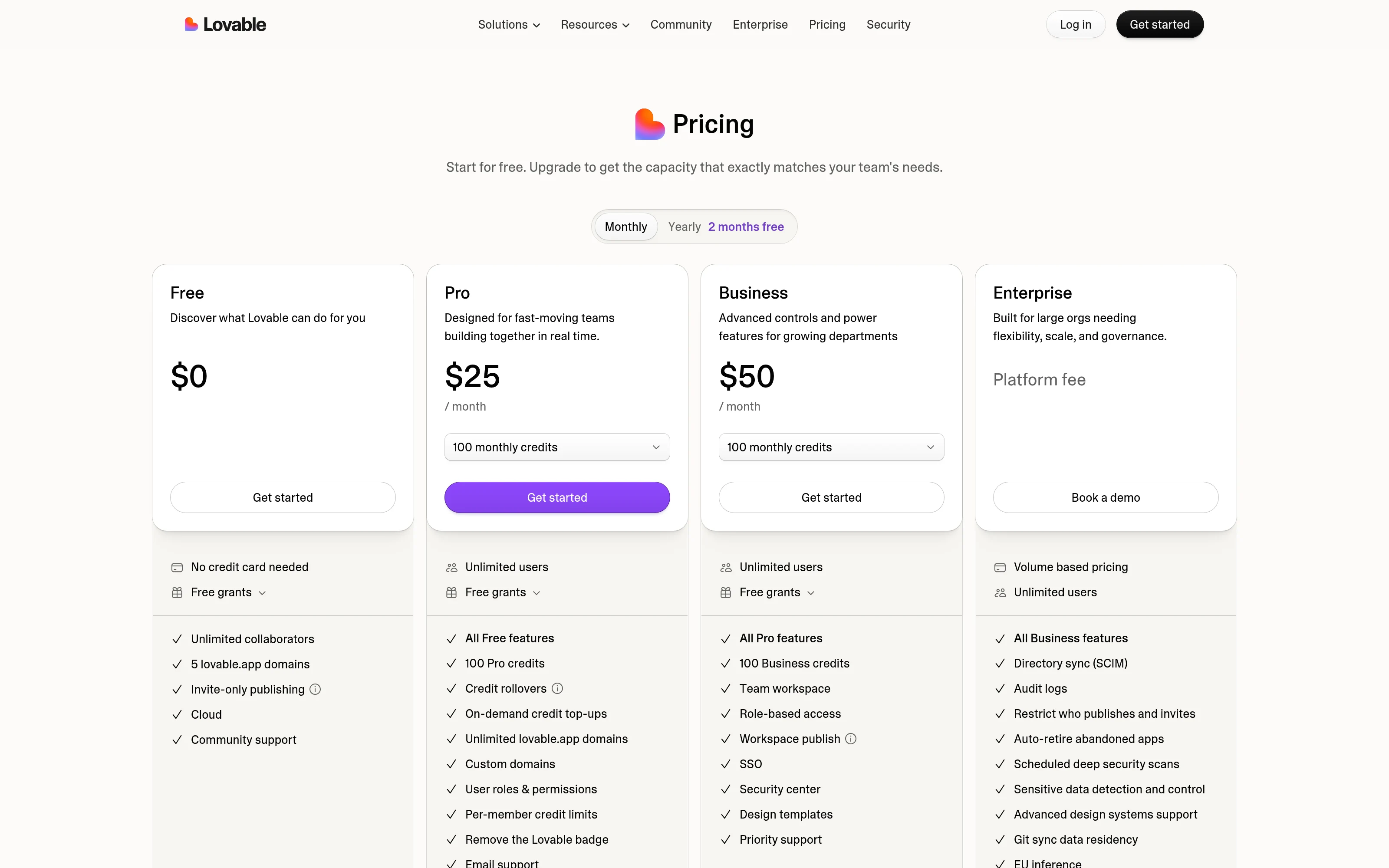
Lovable’s current pricing page describes plans as workspace‑based rather than seat‑based: you buy a credit bundle for a workspace, and any number of members can be added, with all members drawing from the same shared credit pool, rather than being billed per user.Lovable Pricing sets out this model. That matters for non‑technical teams in Kuwait and the UAE, because founders, ops staff and product people can all prompt the same app without extra seats.
Plan overview in plain language
| Plan | Price (USD) | What you get | Best for |
|---|---|---|---|
| Free | $0 / workspace / month | Lovable’s November 2026 pricing and billing‑update pages state that all plans, including Free, receive a daily grant of 5 build credits and a monthly grant of 20 Cloud credits, and the billing update adds that Free workspaces also receive 4 AI credits per month for in‑app AI features. The Free tier publishes apps on a lovable.app subdomain. Lovable’s own pricing page does not document the 30‑credits‑per‑month cap some third‑party sites mention, and it does not provide a detailed matrix of which add‑ons (such as custom domains or top‑ups) are unavailable on Free, so those specifics should not be asserted without qualification. | Students, prototypes, solo founders willing to move slowly. |
| Pro – 100 credits | $25 / month | Pro – entry‑level credit tier – As of October–November 2026, Lovable’s own pricing UI (as captured by contemporary primary‑source screenshots and subscription‑plan docs) shows a Pro tier starting at 100 credits for $25/month, with higher Pro tiers offering more credits at higher monthly prices. All plans receive the same daily build and monthly Cloud grants, and the pricing page notes that Pro is aimed at individuals and smaller teams; Pro workspaces can use custom domains according to the plan descriptions in Lovable’s app and help content. | Most early‑stage MVPs and SME apps. |
| Pro – higher tiers | Varies | Pro – higher tiers – Lovable’s pricing UI offers additional Pro credit tiers above the 100‑credit entry level, with higher monthly prices and larger credit bundles. Exact maximum credits and prices for the highest Pro tiers are only visible inside Lovable’s live pricing interface and subscription‑plan configuration, and should be checked directly there before quoting specific figures. | Teams running multiple apps or iterating heavily. |
| Business | Varies | Business – Lovable’s Business plan is sold in the same credit‑based structure as Pro but is positioned for organisations that need SSO and additional governance features. Contemporary screenshots and subscription‑plan docs show Business starting at a higher per‑credit dollar price than Pro, with similar daily build and monthly Cloud grants, but the exact current entry price, included credits and feature list should be confirmed directly in Lovable’s pricing UI or sales materials before being quoted. | Companies needing SSO and a more formal setup. |
| Enterprise | Custom | Volume‑based credits with enterprise features and support. | Larger organisations with security and support requirements. |
Any specific prices, credit quantities or feature limits in this section should be sourced directly from Lovable’s official pricing page, subscription‑plan configuration and documentation as of the date of publication; third‑party summaries such as AI Agent Duo or Gravity Fast can provide additional colour but should not override the latest official figures. For a more narrative walkthrough of these tiers, see the separate guide on Lovable plans, credits and real monthly cost.
What a Lovable credit actually is
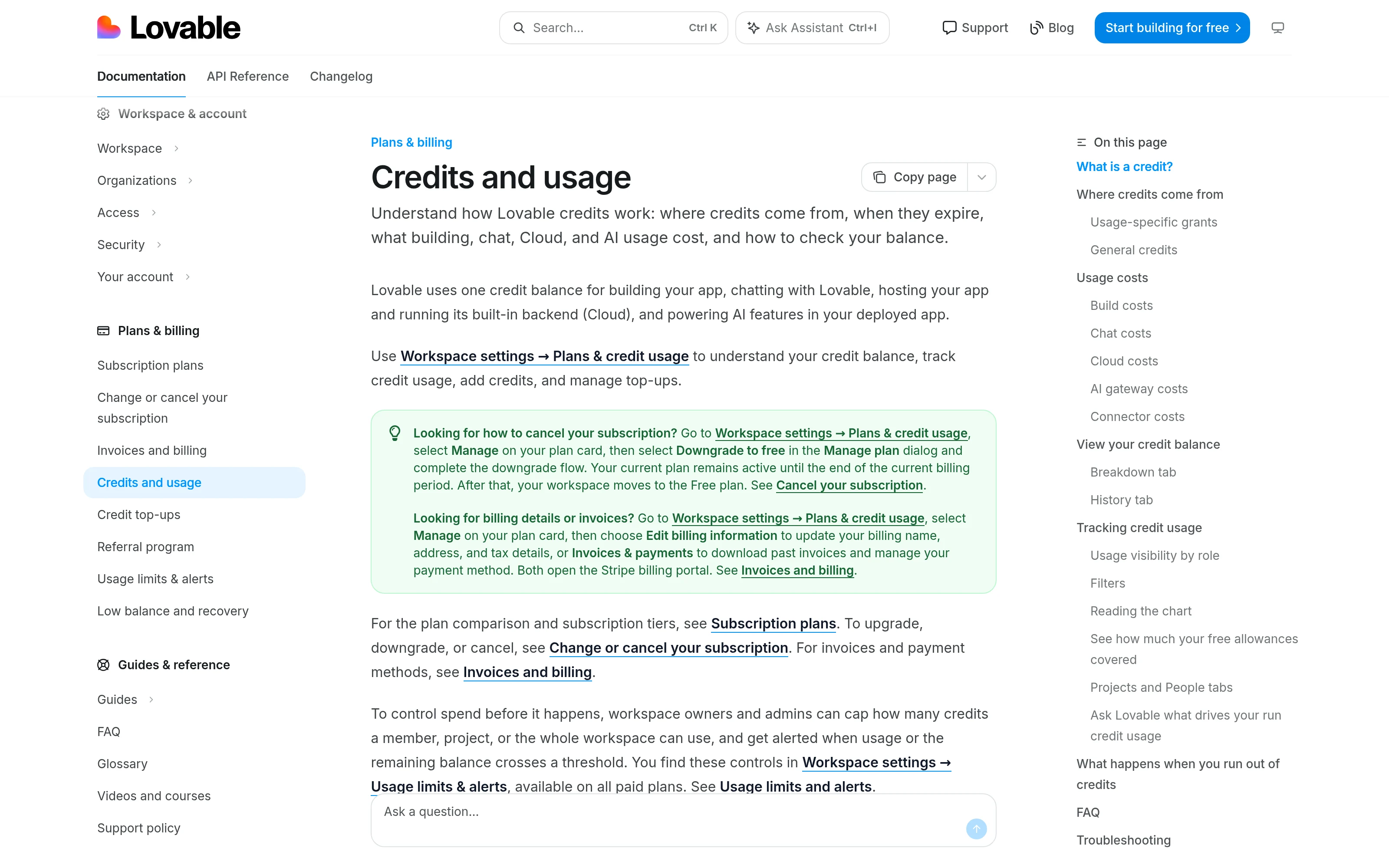
Lovable’s credits‑and‑usage documentation defines a credit as the single unit that pays for multiple categories of usage from one shared balance, including Build (project chats where Lovable generates or edits app code), Chat (conversational usage not tied to a specific app), Cloud (hosting and databases for live apps) and AI gateway (model calls triggered inside deployed apps).Lovable’s credits and usage docs describe these categories. You do not have separate bills for building versus hosting; there is only one balance.
Credits are used for:
- Build – chat messages where Lovable generates or edits app code.
- Chat – standalone chats or automations not tied to a specific app.
- Cloud – hosting, databases and backend for live apps.
- AI gateway – model calls your users trigger inside deployed apps.
The docs clarify that “Build” and “Run” are reporting views, not separate balances.Credits and usage emphasises that both draw from the same pool. That is the core pricing idea: one bucket for everything.
Grants that sit on top of paid credits
Lovable’s pricing page and a June 2026 billing update explain that every plan, including Free, gets the same daily and monthly grants:Billing update
- 5 build credits/day – used automatically when you build; expire at the end of the day.
- 20 Cloud credits/month – used for hosting before paid credits are touched.
- 4 AI credits/month on Free – used for in‑app AI features before paid credits.
For smaller or new apps, Lovable’s pricing FAQ states that hosting is typically fully covered by the included Cloud grant, with only “significant visitor traffic and/or size” drawing extra from your balance.Lovable Pricing makes this point. There are no published per‑GB or per‑request numbers, so for a Gulf SME this means early‑stage hosting is likely cheap or free, but forecasting the cost of a future high‑traffic app is harder.
Inside Lovable credits: how far does a credit really go?
To understand end‑to‑end cost, it helps to build an intuition for how quickly credits burn when you build and iterate. Lovable’s pricing FAQ includes an example table of build actions with indicative credit costs in Default Mode.Lovable Pricing FAQ provides the following samples:
| Action | Indicative cost (credits) | What that means in USD on Pro 100 |
|---|---|---|
| Change a button colour | 0.50 | 0.5 × $0.25 ≈ $0.13 |
| Remove the footer component | 0.90 | 0.9 × $0.25 ≈ $0.23 |
| Add sign‑up and login auth | 1.20 | 1.2 × $0.25 ≈ $0.30 |
| Generate multi‑section landing page with images | 1.70 | 1.7 × $0.25 ≈ $0.43 |
The dollar figures assume an effective rate of $0.25 per credit on the 100‑credit Pro tier, based on Gravity Fast’s per‑credit analysis.Lovable Pricing 2026 calculates this for that tier.
These sample costs suggest that even non‑trivial changes cost fewer than 2 credits when Lovable can predict the scope from the prompt. In practice, total spending depends more on how many times a team goes back‑and‑forth (“fix it”, “change that again”) than on the cost per individual operation. If you want a more tactical view of how to keep those back‑and‑forth cycles efficient, there is a separate prompt script for taking a Lovable MVP from idea to production without wasting credits.
Default Mode vs Plan Mode
Lovable’s pricing page describes two build modes:Pricing
- Default Mode – credits vary by task complexity (as in the examples above).
- Plan Mode – 1 credit per message, regardless of complexity.
For the cost ranges in this article, Default Mode examples from Lovable’s FAQ are used as anchors, because they show the lower and upper bounds of common edits. Plan Mode makes credit usage easier to predict per prompt but can be more expensive if many short messages are sent.
Effective per‑credit pricing and top‑ups
Gravity Fast’s breakdown of Lovable pricing explains the effective per‑credit prices and top‑ups:Gravity Fast
| Plan / purchase | Credits | Price (USD) | Effective price/credit |
|---|---|---|---|
| Pro – 100 credits | 100 | $25/month | $0.25 |
| Pro top‑up | 50 | $15 one‑off | $0.30 |
| Business – 100 credits | 100 | $50/month | $0.50 |
| Business top‑up | 50 | $30 one‑off | $0.60 |
Business credits are priced higher per unit, but Lovable’s pricing FAQ states that run and AI costs are calibrated so Business workspaces do not pay more overall for equivalent hosting and AI usage.Lovable Pricing explains this equivalence.
Credit expiry and why it matters for sporadic builders
Lovable’s docs and pricing page specify different expiry rules:Credits and usage, Pricing
- Daily build grants expire at the end of each day.
- Monthly plan credits expire two months after issue if unused.
- Annual plan credits expire one month after the annual period ends.
- Top‑up credits last 12 months from purchase.
This makes Lovable suitable for focused build sprints, but risky if the pattern is “work a bit, disappear for months”. For a Gulf founder juggling a day job or a busy SME operator, unused credits are a real waste: if credits are pre‑paid and then development pauses, part of that budget simply expires.
Scenario 1 – simple marketing site or landing page
This scenario covers a brochure site or landing page with a contact form and perhaps one simple AI feature, such as an FAQ bot answering common questions for a clinic, restaurant or local services business in Kuwait or the UAE.
Lovable credit model for a marketing site
Based on Lovable’s example credit costs,Pricing FAQ a multi‑section landing page with images costs about 1.7 credits to generate. Layer on a few iterations:
- Initial layout and core sections – ~1.7 credits.
- 5–10 small edits (colours, text tweaks, rearranging sections) – assume 0.5–1 credit each, or ~2.5–10 credits.
That puts the initial build in the 6–12 credit range. At $0.25/credit on Pro, 12 credits equates to about $3 of actual paid credits. Daily build grants can cover most or all of this if work is spread over a few days.
Hosting for a low‑traffic site is likely fully covered by the 20 Cloud credits/month Lovable grants on every plan.Lovable Pricing explicitly states that smaller or new apps are typically covered entirely by the grant. Free plan users also receive 4 AI credits/month, which can power a modest FAQ bot without touching paid credits.
Including a realistic ‘fix factor’
In practice, most projects involve changes of mind. To model this, apply a “fix factor” – an uplift on initial build credits to represent debugging and back‑and‑forth prompts:
- Initial build: 6–12 credits.
- Fix factor (30–70%): +2–8 credits.
A reasonable total range is 8–20 credits end‑to‑end. At $0.25/credit, that is $2–$5 of paid credits, often fully absorbed by the daily grants if iteration is paced.
Free vs Pro for a marketing site
- Lovable Free – With 5 daily build credits, plus 20 Cloud and 4 AI credits, a solo founder can build and host a basic marketing site on a
lovable.appdomain at $0 cash cost, if slower iteration and no custom domain are acceptable. Third‑party write‑ups such as TraceCheck note that custom domains require a paid plan,Lovable Credits & Domains and Lovable’s own pricing UI associates custom domains with paid tiers. - Lovable Pro 100 – At $25/month, this tier effectively pre‑pays for 100 credits plus grants. In this scenario only a small fraction of that may be used; the tangible benefit is a custom domain and faster, less constrained tweaking.
Freelancer comparison for a marketing site
For a Gulf‑accessible remote full‑stack freelancer at roughly $50/hour, even a lean 10–20‑hour engagement for a custom landing page and contact form can land in the $500–$1,000 range, based on common rate cards and marketplace listings. That excludes later content changes, which are usually billed in additional hours.
Lovable vs freelancer for Scenario 1:
- Lovable – $0 on Free, or $25 for one month of Pro and a handful of credits used.
- Freelancer – often in the $500–$1,000 range upfront for equivalent work.
For a simple marketing site with stable requirements, Lovable commonly wins on cost, especially for Kuwait/UAE SMEs that would otherwise struggle to justify a $1,000 brochure site. If you are deciding between Lovable and a more traditional GitHub + Vercel stack for this kind of lightweight MVP, it is worth skimming the comparison on Lovable vs GitHub + Vercel for a first real MVP.
Scenario 2 – CRUD business tool (inventory or booking system)
This scenario covers small internal tools such as inventory trackers, booking systems for a salon or clinic, or basic CRM‑style dashboards. These need authentication, a database and some workflows, but not yet full multi‑tenant SaaS complexity.
Lovable build credits for a CRUD tool
Using Lovable’s indicative build pricing as anchors:Pricing FAQ
- Adding authentication – ~1.2 credits (Lovable’s own example).
- Creating several screens (inventory list, item detail, bookings calendar) – each likely involves multiple prompts and UI passes.
- Adjusting the data model, wiring basic workflows, and styling – additional iterations across the app.
For a realistic small tool, budgeting 30–60 credits for the initial build phase is one reasonable assumption. This allows for multiple chat cycles to define entities, screens and flows.
Adding a fix factor
Business tools inevitably involve more edge cases (permissions, validation, special fields). Applying a 50% fix factor to the build credits gives:
- Initial build: 30–60 credits.
- Fix factor (50%): +15–30 credits.
- Total: ~45–90 credits from idea to stable v1.
On Pro 100 at an effective $0.25/credit, 45–90 credits equates to $11–$22.50 of credit value, within a $25 Pro month if work is concentrated. Since Pro 100 includes 100 credits plus daily grants for $25, one month is often enough if the build is intensive; if work is spread out or usage overshoots 100 credits, it may spill into a second month.
Hosting and AI run costs for a CRUD tool
Lovable’s pricing FAQ notes that hosting for smaller or new apps is usually fully covered by the 20 Cloud credits/month grant.Pricing The type of internal tool described here—used by a small team in a Gulf SME—fits that “smaller app” profile. As long as usage stays modest, Cloud costs will likely not eat into the paid credits, especially in the first few months.
AI gateway usage only applies if AI features are embedded into workflows (for example, automatic description generation). For a basic CRUD tool without AI, run‑phase spending should stay close to zero beyond the grant.
Freelancer comparison for a CRUD tool
A custom inventory or booking system with auth, multiple screens and database logic is materially larger than a landing page. Common freelance estimates reported on job platforms and agency sites include:
- Hours: 40–80 hours for a mid‑market full‑stack freelancer.
- Rate: using a conservative $50/hour benchmark drawn from typical marketplace rates.
- Fee band: $2,000–$4,000 for the initial build.
This does not include an ongoing retainer for fixes and enhancements, which many agencies in the UAE and wider Gulf require for business‑critical tools.
Lovable vs freelancer for Scenario 2:
- Lovable – one to two months of Pro 100: roughly $25–$50 total, with hosting initially covered by Cloud grants in many cases.
- Freelancer – often quoted in the $2,000–$4,000 range, plus later maintenance.
Here Lovable can undercut freelance costs by roughly an order of magnitude, provided prompt quality is managed and uncontrolled iteration is avoided.
Scenario 3 – small SaaS app with multi‑user roles and AI
The third scenario is a more complex SaaS‑style app, such as a niche B2B dashboard with multi‑user roles, richer database relations and AI woven into key workflows (for example, automated report summaries). This is the sort of app many founders in Kuwait and the UAE want to validate before committing large budgets.
Lovable credits for a SaaS‑style v1
Compared with Scenario 2, a small SaaS usually has:
- Multiple modules or sections (analytics, reporting, settings, billing, etc.).
- Role‑based access control and permissions.
- Heavier AI usage inside the app.
Normalising Lovable’s build examples to this level of complexity, one conservative end‑to‑end range is:
- Initial build: 70–150 credits across modules and flows.
- Fix factor (50–70%): +50–100 credits.
- Total: approximately 120–250 credits from idea to usable SaaS v1.
At an effective $0.25/credit on Pro, 120–250 credits equate to $30–$62.50 worth of credits. In practical terms:
- Two to three months on Pro 100 ($25/month) could cover this if the build is paced and daily grants are leveraged.
- To move faster, a workspace might opt for a higher Pro tier or add a Pro top‑up of 50 credits for $15 when needed.
A plausible cash budget for such a SaaS build on Lovable is in the low hundreds of dollars over a few months, combining base plan fees and potential top‑ups, but actual spend will vary with usage.
Hosting and AI usage as traffic grows
Lovable’s docs make clear that the same credits cover Cloud and AI gateway usage at runtime.Credits and usage For early beta users, the 20 Cloud credits/month grant may still cover most hosting, but as paying customers are added, apps begin to draw more from the paid credit pool.
Since Lovable does not publish per‑unit Cloud/AI prices, it is not possible to calculate “X dollars per 1,000 requests” in the way that can be done on Supabase or a hyperscale cloud. Instead, teams must monitor the usage dashboard and treat Cloud and AI categories as part of an overall monthly credit budget. For a more detailed look specifically at run‑phase behaviour, the article on Lovable run credits and Cloud/AI costs goes deeper into what happens once real traffic arrives.
Freelancer/agency comparison for a SaaS app
Custom SaaS builds generally command much higher quotes than simple tools. Market anecdotes and agency rate cards for remote teams accessible from the Gulf often sit in these ranges:
- $8,000–$15,000 for a relatively simple SaaS MVP.
- $15,000–$30,000+ for richer multi‑module products.
These figures reflect design, backend, frontend, auth, AI integrations and deployment, plus some support period. They also often assume follow‑on retainers for feature work once there are users.
Lovable vs freelancer for Scenario 3:
- Lovable – many teams can aim to keep spend in the low hundreds of dollars over two to three months for credits and early hosting to get a solid SaaS v1 live, depending on usage.
- Freelancer/agency – quotes of $8,000–$30,000+ are common for an equivalent custom build.
Here Lovable’s apparent cost advantage is very large, but only if teams can work within Lovable’s managed backend and accept less predictable Cloud/AI run‑rates as traffic scales.
How Lovable’s pricing compares to freelance rates
Summarising the three scenarios side by side:
| Scenario | Lovable credits used (incl. fix factor) | Lovable cash spend (Pro tiers) | Freelancer hours | Freelancer fee (@ $50/h) |
|---|---|---|---|---|
| 1 – Marketing site | 8–20 | $0 on Free, or part of one $25 Pro month | 10–20 | $500–$1,000 |
| 2 – CRUD tool | 45–90 | ~$25–$50 | 40–80 | $2,000–$4,000 |
| 3 – Small SaaS | 120–250 | Low hundreds of dollars over 2–3 months (plan‑dependent) | 160–600+ | $8,000–$30,000+ |
These freelancer fee bands use a benchmark of $50–$80/hour for mid‑market full‑stack freelancers drawn from public rate cards and marketplace listings, with $50/hour used as the conservative base. For founders in Kuwait or the UAE, it is often possible to hire remote freelancers near that rate; local agencies typically price higher.
The pattern is consistent: for smaller apps and early SaaS v1s, Lovable’s out‑of‑pocket cost is typically in the tens or low hundreds of dollars, where even lean freelance projects sit in the thousands.
Where Lovable’s ‘cheap’ story can break down
Lovable’s pricing is not universally cheaper. There are clear situations where its cost advantage narrows or flips.
1. Uncontrolled fix loops and credit burn
Because Lovable charges per build interaction, repeatedly asking it to “try again” or “completely change the layout” can double or triple credit usage. The structured fix factors used above (30–70%) assume some discipline in prompting. If iteration is endless without a plan, it is easy to overspend, especially on top‑ups which cost more per credit.
2. High‑traffic, data‑heavy apps
Lovable does not publish unit prices for Cloud or AI gateway consumption. Instead, its pricing FAQ states that hosting for smaller apps is covered by the grant, and high‑traffic or large apps will consume more credits.Pricing For a genuinely high‑traffic customer portal or content‑heavy product, this opacity makes it hard to know whether Lovable or a tuned Supabase/Vercel stack is cheaper at scale.
3. Sporadic builders and credit expiry
If work only happens in short bursts separated by long gaps, credit expiry can erode value. Monthly credits expire after two months, while top‑ups last 12 months.Credits and usage For founders likely to pause for half a year, a more traditional stack with non‑expiring resources might waste less money, even if per‑unit hosting is higher.
4. Deeply custom infrastructure or integrations
Lovable is optimised for common web‑app patterns on top of Supabase.AI Agent Duo notes that it uses Supabase’s open‑source foundation for database, auth and functions. If a project demands bespoke infrastructure, unusual data residency, or intricate on‑prem integrations, a freelancer on a conventional stack may be a better long‑term fit even if the initial build is more expensive.
Run‑phase costs: hosting, AI gateway and what happens at zero credits
Beyond the build, it is important to understand what it costs to keep the app running and what happens if credits run out.
Cloud and AI gateway from the same bucket
Lovable’s credits and usage docs specify that the same unified balance pays for both Cloud hosting and AI gateway calls.Credits and usage The June 13, 2026 billing update confirms that Lovable merged what used to be separate Build and Cloud/AI balances into one, without changing plan prices or grant levels.Billing update
For smaller or new apps, Lovable’s pricing FAQ suggests that the 20 Cloud credits/month grant covers hosting in full, so early‑stage Gulf SMEs launching a new product likely see minimal run cost. As traffic and AI usage grow, those run costs start eating into the main credit pool.
What happens when credits reach zero
Gravity Fast’s analysis summarises Lovable’s overage behaviour:Gravity Fast
- Building cannot continue once paid credits are exhausted, beyond daily free build grants.
- AI features in a live app can fail with HTTP 402 (Payment Required).
- The backend may pause certain operations if Cloud/AI usage continues without credits, but static sites generally remain available.
This design protects Lovable from unbounded resource usage but means credits must be monitored to avoid outages in AI features, especially for customer‑facing apps in markets like the UAE where expectations are high.
Decision guide: when Lovable beats a freelancer (and when it doesn’t)
Returning to the core decision—Lovable vs freelancer—there are clear patterns where each option makes more sense.
When Lovable usually wins
- Simple, stable requirements – For marketing sites and straightforward internal tools with light traffic, Lovable’s Free or entry‑level Pro plans can deliver the whole project inside daily and monthly grants, making freelance minimum fees hard to justify.
- Non‑technical teams wanting rapid iteration – Unlimited workspace members and chat‑driven edits let founders and operators tweak the app weekly without renegotiating developer contracts.
- Pre‑revenue SaaS validation – For Kuwait/UAE founders testing a SaaS idea before raising or committing capital, spending in the low hundreds of dollars to reach a live v1 on Lovable is often far less risky than commissioning a build quoted in the thousands.
- Students and solo operators – The Free plan, daily build grants and student discounts at lovable.dev/students make Lovable accessible for experimentation without major spend.
When a freelancer or agency is safer
- High‑traffic, data‑heavy portals – When it is known from day one that an app will handle heavy traffic, large datasets or strict SLAs, a transparent stack like Supabase/Vercel with clear per‑unit pricing is easier to forecast and tune.
- Sporadic work patterns – If work is expected in bursts with months of inactivity, credit expiry can waste budget. Traditional hosting bills may be more predictable.
- Strict compliance or custom infra needs – Banks, healthcare providers and regulated entities in the Gulf may require bespoke security posture, data residency and audit trails that are easier to contract for via an agency.
- Engineering‑led teams with a preferred stack – If a team already uses GitHub, Supabase and CI/CD, Lovable’s abstraction may add more friction than value.
Practical budgeting rules for Lovable founders
For founders and SMEs planning to use Lovable instead of a freelancer, a few budgeting rules emerge from the credit and pricing model.
1. Treat credits as a scoped project budget
Before starting, pick a total credit budget for v1 and allocate it between build and fix:
- Marketing site: up to 20 credits total.
- CRUD tool: up to 90 credits total.
- SaaS v1: up to 250 credits total.
Then reverse‑engineer how many Pro months or top‑ups are actually needed. This keeps Lovable comparable with a fixed‑fee dev quote.
2. Ring‑fence a fix‑loop allowance
Instead of mentally spending 100% of the credit budget on “build”, deliberately allocate 30–70% as a fix‑loop pool. For example, in a 90‑credit CRUD budget, decide that 60 credits are for initial build and 30 are reserved for debugging and UX refinements. When the fix pool is nearing zero, re‑prioritise rather than casually topping up.
3. Optimise prompts to reduce unnecessary iterations
Because credits are consumed per build interaction, clear prompts reduce waste. For Gulf SMEs and founders working in English and Arabic, this means:
- Writing detailed initial specs in one language (usually English) with structured bullet points.
- Batching multiple small changes into one prompt when reasonable.
- Avoiding “play around with it” instructions that lead to many micro‑tweaks.
This is not about learning to code; it is about project scoping in natural language.
4. Monitor Cloud/AI usage once real users arrive
As soon as there are external users, the workspace’s usage view is worth checking weekly. Lovable’s docs explain that Build and Run are just reporting categories over the same balance,Credits and usage so a spike in Cloud or AI gateway usage will shorten how far credits go. For customer‑facing apps in Kuwait or the UAE, pairing this with a simple internal alert (“top up when credits < X”) helps avoid AI features failing with 402 errors.
5. Time build sprints against expiry
Because monthly credits expire after two months, it often makes sense to plan focused 4–8‑week build sprints rather than spreading work thinly over a year. If a long pause is expected (for example, over summer), one option is to drop to Free or the lowest Pro tier and rely mostly on daily grants until work resumes.
What changes the decision
The right choice between Lovable and a freelancer can flip based on a few key conditions.
- Simple, stable requirements and light traffic – Favour Lovable Free or Pro. Daily build and monthly Cloud grants can cover most costs; freelance minimum fees are hard to justify.
- Heavy traffic or complex AI from day one – Consider a traditional custom build on Supabase/Vercel or similar. Transparent per‑unit pricing makes forecasting easier.
- Non‑technical team wanting weekly iteration without retainers – Lovable’s unlimited‑member workspaces and chat‑driven edits can be more flexible than relying on a single freelancer’s bandwidth.
- Sporadic, long‑gap development pattern – Either compress work into a short, intense Lovable window, or use a more conventional stack with non‑expiring resources.
- Need for deep custom infra or CI/CD – Hiring a freelancer or agency on a mainstream stack may be preferable; Lovable’s managed Supabase backend is not designed for unusual deployments.
- Organisation requiring SSO and formal support – Lovable Business or Enterprise may be a better fit than individual freelancers, due to SSO and enterprise‑oriented features.
Key takeaways
- Lovable’s unified credit system means one budget for build and run. Every plan gets daily build and monthly Cloud grants, with Free also getting AI credits.
- For simple sites and internal tools, Lovable can replace a freelancer entirely. Expect to spend between $0 and around $50 instead of hundreds or thousands of dollars in many common cases.
- For small SaaS apps, Lovable can often deliver a v1 for a few low‑hundred dollars or less. Comparable freelance builds regularly land in the thousands to tens of thousands of dollars.
- The main risks are uncontrolled fix‑loop credit burn, opaque high‑traffic run costs and credit expiry. Treat credits as a scoped budget with an explicit fix allowance.
- For high‑traffic, regulated or deeply custom projects, traditional stacks and agencies are still safer. Especially when accurate hosting forecasts and strict compliance matter.
FAQ
How many Lovable credits are needed to build a basic business app?
For a simple internal tool with auth and a few screens, a realistic working estimate is 45–90 credits from idea to stable v1, including a fix‑loop allowance. On Pro 100 at $25/month, that typically fits within one or two months of included credits plus daily build grants, assuming usage is managed.
Can a marketing site be launched on Lovable without paying anything?
Yes, if the lovable.app subdomain is acceptable and iteration can be paced. The Free plan includes daily build credits, 20 Cloud credits and 4 AI credits per month, which are usually enough to build and host a basic marketing site for a Gulf SME at zero cash cost.
What does hosting cost on Lovable after launch?
Lovable states that hosting for smaller or new apps is typically fully covered by the 20 Cloud credits/month grant on each plan. Only apps with significant visitor traffic or large size draw additional Cloud usage from the main credit balance, and exact unit prices are not published.
What happens to an app if Lovable credits run out?
When paid credits reach zero, building cannot continue beyond daily grants, and AI features in a live app may return payment‑required errors. The underlying site can remain live, but Cloud and AI gateway activity are constrained until credits are added or the next grant cycle begins.
Is Lovable cheaper than hiring a freelancer in Kuwait or the UAE?
For most simple sites, internal tools and early SaaS v1s, Lovable is usually far cheaper, often costing under a few hundred dollars end‑to‑end versus thousands for a freelancer or agency, based on typical market rates. The gap narrows for high‑traffic, complex or compliance‑heavy projects where predictable infrastructure and long‑term support matter more than the initial build price.
Where can I learn how to actually drive Lovable day to day?
This article focused on cost. If you want practical prompting scripts and workflows that keep build and run costs under control while you ship real features, start with the guides on Lovable prompts for production SaaS and setting up monitoring on a Lovable app after publishing.