Tabby vs Tamara for UAE merchants: when BNPL helps profit
Compare Tabby vs Tamara for UAE merchants: fees, settlement time, refunds and cash flow so you can decide to use Tabby, Tamara, both or neither.
For a UAE e-commerce merchant, both Tabby and Tamara look similar on the surface: Central Bank–linked BNPL, pay-in-4, and you get paid up front. The real difference is what you pay in commission, how refunds are charged, how fast you get settled, and how well they fit your platform and markets. Based on documented behaviour and merchant-reported ranges, Tabby often works out cheaper on a percentage-fee basis for UAE-focused stores, while Tamara can make sense as a second provider when you expand across more GCC markets—subject to your actual contract terms. If your gross margin is below roughly 25–30% or you sell high-return categories, you should be cautious about BNPL at all. If you are still getting your overall payment stack right, read this alongside guides such as how I would set up payments for a new Dubai business, Stripe for business in the UAE and the broader GCC comparison KNET, Tap, Ziina, Tabby, Tamara or Stripe? so BNPL sits inside a coherent payments plan rather than as a one-off add‑on.
Quick verdict
For most UAE online stores on Shopify or WooCommerce with healthy margins (30%+), Tabby is usually the first BNPL to add: it is well known locally, integrates cleanly, and indicative merchant reports place its commission in the ~3–5% range of order value, often at the lower end of the market.Middle East Ecom’s comparison notes Tamara’s typical merchant commission slightly higher at ~4–6%. Tamara becomes attractive once you already see strong BNPL usage and want extra reach in GCC markets such as Kuwait, and—where locally available—other currencies that Tamara supports according to integrator documentation. Always confirm current country availability (for example, recent Central Bank or provider announcements about Bahrain and Oman) before planning on Tamara as a primary option there. Low-margin or high-return merchants should treat BNPL as optional and negotiate very hard, because, in the example scenarios below using typical commission ranges, combined commission and refund fees can remove around 1–2 percentage points from total revenue. If you are still deciding where BNPL fits against cards, wallets and cash on delivery, compare this with the trade‑offs in cash on delivery in Gulf ecommerce: when it still pays and when to cap it.
| Option | Best for | Indicative starting commission (UAE) | Main strength | Main limitation |
|---|---|---|---|---|
| Tabby only | UAE/Saudi-focused Shopify & WooCommerce stores with 30%+ gross margin | ~3–5% of order value (merchant-reported, not list price) | Strong UAE brand, official integrations, often lower commission band | Weekly settlement impacts cash flow; refund fees can reduce profit |
| Tamara only | Stores targeting KSA and the UAE, and selectively adding other GCC markets such as Kuwait and any additional countries where Tamara is currently live and onboarding merchants. | ~4–6% of order value (merchant-reported, not list price) | Broader GCC currency coverage via some integrators; good shopper recognition in KSA | Higher typical commission; fees may be retained on refunds |
| Both Tabby & Tamara | Established brands optimising conversion and GCC reach | Blended ~3–6% on BNPL share of orders | Maximum shopper choice; may lift BNPL adoption and conversion | More complex reconciliation; slightly higher blended fees |
| Neither (cards + COD + wallets only) | Low-margin, high-return or cash-flow-sensitive merchants | Standard gateway fees only | Simpler operations and faster settlement via gateways | Missed uplift from customers who insist on instalments |
Overview: Tabby vs Tamara for UAE merchants (as of late 2026)
Buy-now-pay-later (BNPL) lets shoppers split purchases into interest-free instalments (for example, pay-in-4 or pay-next-month) while the merchant is paid the full amount up front, minus a fee. In the UAE, Tabby and Tamara are two of the dominant BNPL brands on consumer checkouts, including many Shopify and WooCommerce stores. If you are still choosing your core ecommerce stack, read this alongside Shopify vs WooCommerce: choose by cost, control and upkeep so BNPL decisions line up with the platform you actually run.
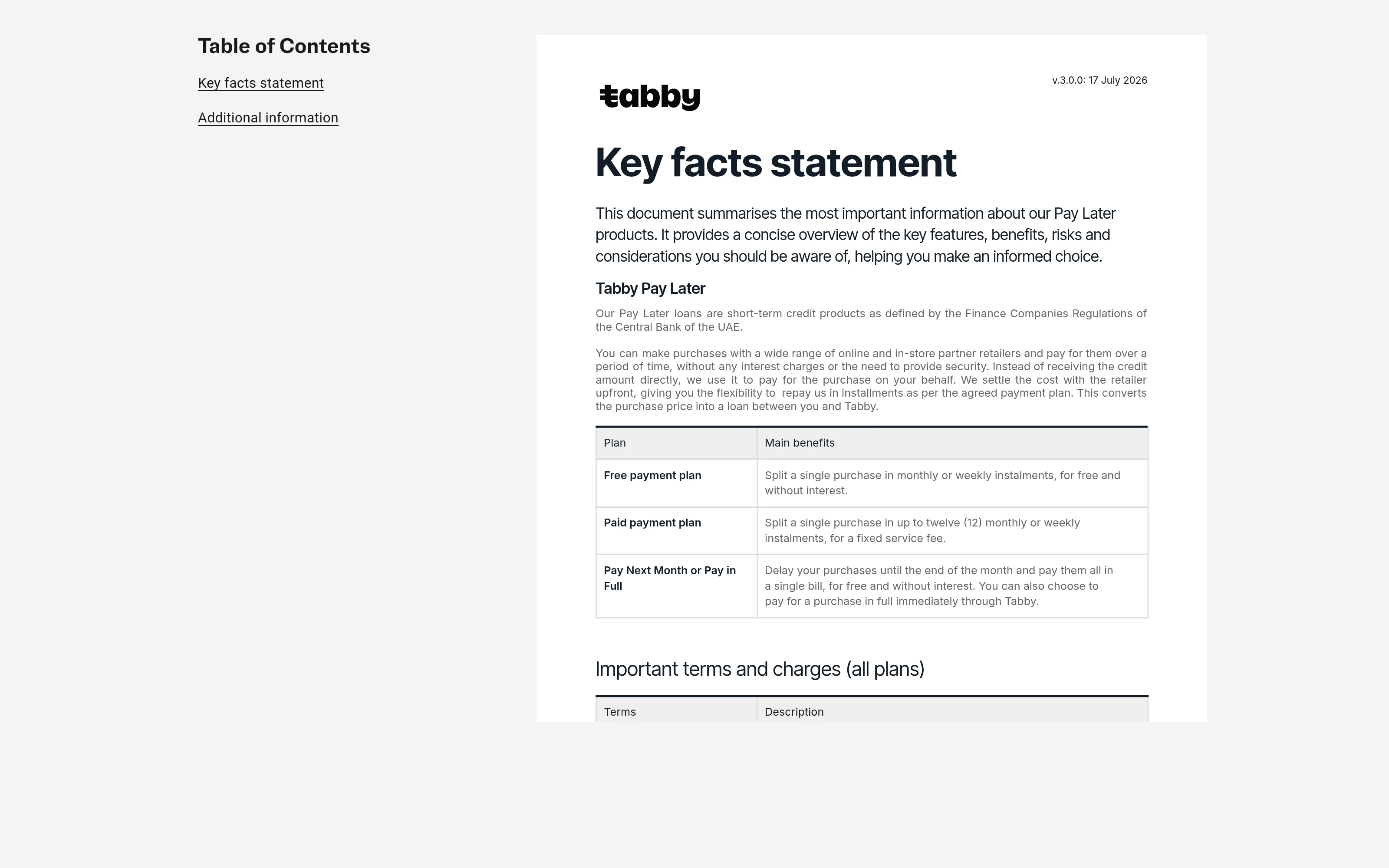
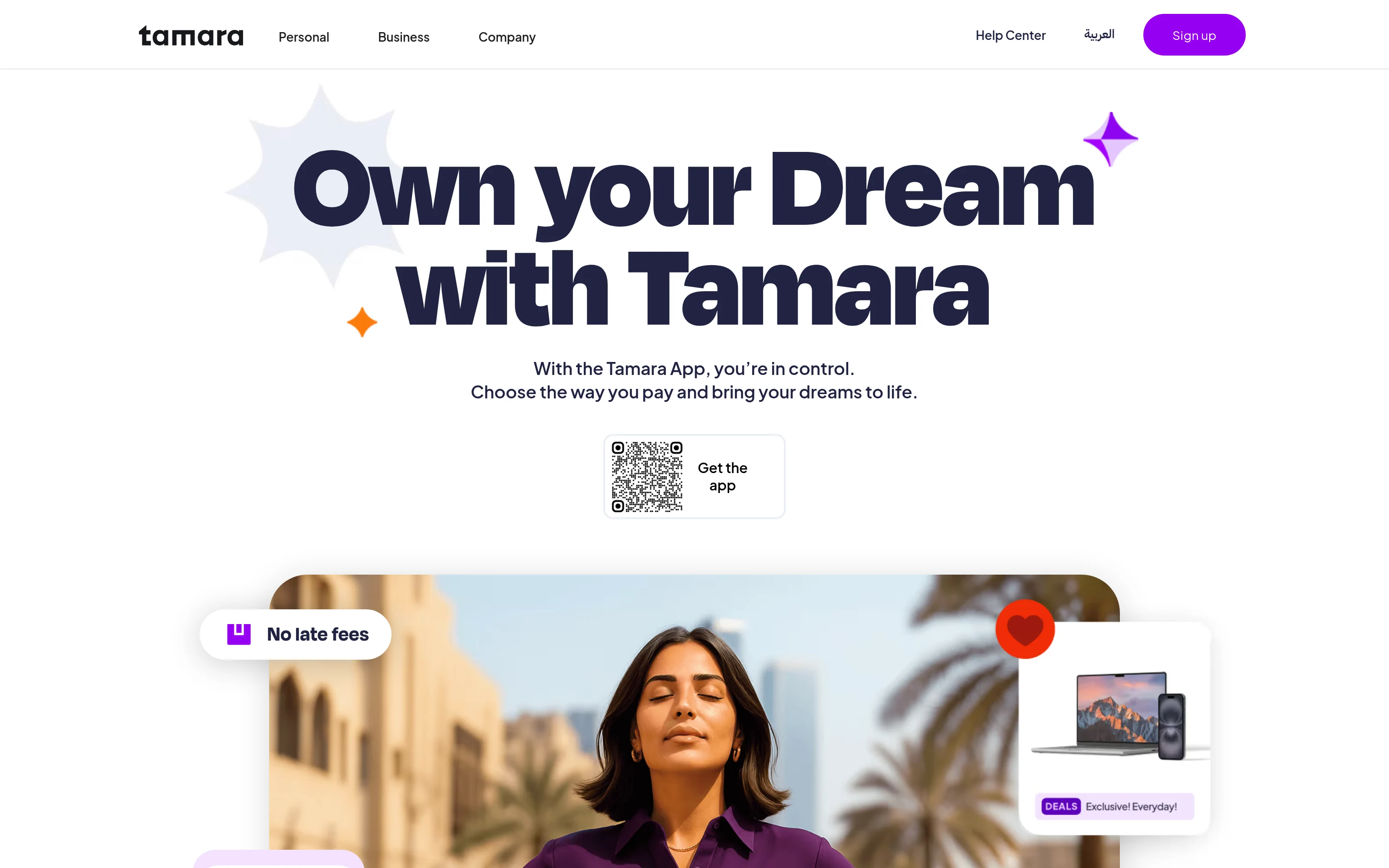
Both Tabby and Tamara link their UAE consumer products to entities that are authorised by the Central Bank of the UAE. Tamara FZE explicitly states on its UAE site that it is “licensed and regulated by the Central Bank of the UAE”, while Tabby Cash and Tabby Payments are listed in the CBUAE register and Tabby publishes key facts statements for its pay-later products in line with CBUAE disclosure rules.Tabby’s key facts statement and Tamara’s UAE page provide those details. Both say they pay merchants up front and take on the shopper credit and collection risk in their standard BNPL products.Tabby’s business overview and Tamara’s how-it-works page emphasise this.
However, neither provider publishes a simple, standard merchant pricing table in the UAE. Both say openly that commission is negotiated per merchant.Tabby for Business and Tamara for Business explain that rates depend on factors like industry and risk. Independent UAE-focused comparisons, such as Middle East Ecom, report that merchant contracts commonly fall in these ranges:
- Tabby: around 3–5% of order value.
- Tamara: around 4–6% of order value.
Those numbers are not official price lists, but they are consistent across multiple specialist blogs. The decision for a UAE merchant is therefore less about a published tariff and more about how each provider’s offer interacts with specific margins, returns, settlement needs and markets.
How BNPL works for a UAE merchant
At a high level, a BNPL transaction with Tabby or Tamara on a UAE store works like this (simplified):
- The shopper adds items to cart and goes to checkout.
- They choose Tabby or Tamara as the payment method.
- The BNPL provider runs its own approval process (existing account, identity checks, internal limits).
- If approved, the order is confirmed in the e-commerce platform.
- The merchant ships or fulfils the order as normal.
- The BNPL provider settles the order amount to the merchant (usually on a weekly schedule), minus its commission and any fixed fees.
- The shopper then repays the BNPL provider over time (for example, in 3 or 4 instalments, or next month).
Both Tabby and Tamara state that they pay merchants the purchase amount up front and carry the credit/collection risk with the shopper.Tabby’s business overview and Tamara’s explanation highlight that shoppers pay no interest on time, and merchants are insulated from default risk.
The merchant’s risk is different:
- Commission and fees: a percentage (and sometimes a fixed fee) is paid on every BNPL order.
- Refund fee logic: providers may keep some or all of their fee on refunded orders, meaning the merchant can lose money on returns.
- Settlement timing: funds are not received immediately; reported practice is weekly payouts, which can strain cash flow.
- Disputes and fraud flags: orders flagged as risky can be delayed or reversed, creating operational complexity.
From the shopper’s side, the main products look similar:
- Tabby: pay-in-4 and pay-in-30 days products in the UAE.Tabby’s shopper page describes these as interest-free for the shopper.
- Tamara: split into 3 or 4 interest-free payments and pay-next-month.Tamara’s how-it-works page outlines these options.
For the merchant, those shopper options do not change the basic economics: the merchant still receives one lump sum per order from the BNPL provider, minus their fee, on a schedule defined in the contract.
Merchant onboarding: who can get approved in the UAE?
Independent UAE guides such as TAIF Marketing’s BNPL explainer and FlexiCommerce’s comparison note that both Tabby and Tamara expect a basic level of formality and trading history before approving a merchant. Common requirements (summarised from those guides and provider messaging) include:
- A valid UAE trade licence in a permitted activity (e-commerce, retail, etc.).
- An active UAE business bank account under the same legal entity.
- A live online store with visible products, prices and policies.
- Clear refund/return and shipping policies.
Exact document lists are not fully published on both providers’ UAE sites; they are typically shared during the onboarding process. Independent merchant-focused articles emphasise that approval is case-by-case and that higher-risk categories (for example, some electronics, travel or services) may face more scrutiny.
In practice, this means:
- Very early-stage sellers without a trade licence or bank account are unlikely to be approved.
- New or high-risk businesses should apply to both providers and compare whichever concrete offers they receive.
Fee structure and indicative commission ranges
Because neither Tabby nor Tamara publishes standard UAE merchant commission tables, the only available percentage ranges come from independent merchant reports. Several UAE-focused guides, including Middle East Ecom and Nodi AI’s overview, cluster around these indicative ranges:
- Tabby: approximately 3–5% of order value.
- Tamara: approximately 4–6% of order value.
These are not official list prices. They are useful only as a directional benchmark for modelling and negotiation. Actual contracts may sit outside these bands.
Additionally, Tabby publishes a separate schedule of charges for its business account card transactions in the UAE.The Tabby Business Account schedule shows:
- Domestic AED card transactions: 0 fee per transaction (before VAT).
- International card transactions: 2.38% of transaction amount (exclusive of VAT).
- Wallet top-ups: 0 fee per top-up.
Those fees relate to Tabby’s business account and cards, not its BNPL commission to merchants, but they confirm the company’s approach to publishing transparent card fees while keeping BNPL commission negotiated case by case.
Refund fee logic
Refunds are where BNPL economics can quietly damage margin.
- Tabby: Tabby’s KSA merchant terms (which are publicly available) state that on a refund, Tabby keeps the full fixed fee plus 2% of the percentage-based component of the original merchant fee.These terms are specific to Saudi Arabia, but they are a clear example of how BNPL providers may retain part of their fee when an order is refunded.
- Tamara: Tamara’s Smart terms and conditions allow the company to retain fees on refunded orders, though the UAE public terms do not publish the exact percentages.Tamara’s Smart T&Cs define settlement and fees and reserve that right.
For a UAE merchant, the implication is straightforward: it is prudent to assume that some portion of the BNPL fee is not returned on a refund unless the contract explicitly states otherwise. This matters most in high-return categories like fashion and footwear.
What this means for your margins: real cost scenarios
The numbers below use standardised assumptions and the indicative commission bands reported by specialist UAE blogs. They are not guaranteed pricing. They are designed to show how BNPL fees interact with margin.
Shared assumptions:
- Average order value (AOV): AED 500.
- 100 orders ⇒ AED 50,000 in revenue.
- 30% of orders paid with BNPL once enabled (30 orders).
- 20% return rate on BNPL orders (6 orders refunded).
Scenario 1: Tabby only, mid-range commission, moderate returns
Assume Tabby at 4% commission (mid-point of 3–5% reported band):
- BNPL fee per BNPL order: AED 500 × 4% = AED 20.
- Fees on 30 BNPL orders: 30 × AED 20 = AED 600.
Now add refunds, using a simplified version of Tabby’s Saudi refund logic: assume Tabby retains roughly half the fee on refunds (AED 10 per refunded order) to illustrate the effect:
- Refunded BNPL orders: 20% of 30 = 6.
- Refund fees retained: 6 × AED 10 = AED 60 on non-earning orders.
Indicative total BNPL cost ≈ AED 600 + AED 60 = AED 660 per 100 orders.
That is around 1.32% of total revenue (AED 660 / AED 50,000) or 4.4% on the BNPL portion. If gross margin is 40–50%, losing ~1–1.5 percentage points on total revenue to BNPL in exchange for potential improvements in conversion and AOV is usually acceptable. If margin is closer to 20–25%, this is significant.
Scenario 2: Tamara only, higher commission, same volume and returns
Assume Tamara at 5% commission (mid-high within 4–6% reported band):
- BNPL fee per BNPL order: AED 500 × 5% = AED 25.
- Fees on 30 BNPL orders: 30 × AED 25 = AED 750.
Refunds, assuming Tamara can retain full fee on refunded orders (allowed by its terms, though exact UAE percentages are not published):
- Refunded BNPL orders: 6.
- Refund fees retained: 6 × AED 25 = AED 150.
Indicative total BNPL cost ≈ AED 750 + AED 150 = AED 900 per 100 orders.
That is around 1.8% of total revenue and 6% on the BNPL portion. For merchants with sub‑30% margins or higher return rates, this is a noticeable hit.
Scenario 3: Running both Tabby and Tamara
Assume 30 BNPL orders split equally (15 Tabby, 15 Tamara), Tabby at 4% and Tamara at 5%:
- Tabby fees: 15 × (AED 500 × 4%) = 15 × AED 20 = AED 300.
- Tamara fees: 15 × (AED 500 × 5%) = 15 × AED 25 = AED 375.
- Total BNPL fees on successful orders: AED 675.
Refunds: keep the same 20% BNPL return rate (6 orders), split 3 Tabby, 3 Tamara.
- Tabby retained fees: 3 × AED 10 = AED 30 (illustrative partial retention).
- Tamara retained fees: 3 × AED 25 = AED 75 (assuming full retention).
- Total refund-related fees: AED 105.
Indicative BNPL cost ≈ AED 675 + AED 105 = AED 780 per 100 orders, or ~1.56% of revenue. Running both providers likely costs slightly more than Tabby alone, but may increase BNPL adoption and conversion if shoppers have a strong preference for one brand.
Scenario 4: Low-margin, high-return stress test
Assume:
- Same AED 50,000 revenue per 100 orders (AOV AED 500).
- Gross margin only 25% ⇒ AED 12,500 gross profit.
- 30% of orders via BNPL (30 orders).
- Higher BNPL return rate: 30% (9 orders).
- BNPL commission at the high end: 6% (similar to upper end of reported Tamara range).
BNPL fees on successful orders:
- 30 BNPL orders × AED 500 × 6% = AED 900.
Refund fees, if full fee retained:
- 9 refunded orders × AED 30 fee retained = AED 270.
Indicative BNPL cost ≈ AED 1,170 per 100 orders.
That is ≈2.34% of revenue and almost 9.4% of gross profit (AED 1,170 / AED 12,500). In this situation, BNPL can quite easily remove close to 10% of gross profit unless it materially lifts sales volume or AOV.
Settlement timing and cash flow impact
Neither Tabby nor Tamara publishes detailed settlement service-level agreements for UAE merchants on their public pages. However, multiple UAE-focused guides based on merchant interviews, such as Middle East Ecom and FlexiCommerce, describe the following patterns:
- Tabby: typically settles merchant payouts on a weekly schedule; the specific payout day and delay are defined in the contract.
- Tamara: also uses weekly settlements, often on a fixed weekly payout day.
By contrast, many UAE payment gateways (for example, local acquirers or global gateways connected to UAE banks) can offer same-day or next-day settlement for card and wallet transactions, depending on the agreement. For a gateway-specific view, see Tap Payments for business: check methods, fees and settlement and Ziina vs Tap Payments: best payment gateway in the UAE.
If a business model relies on paying suppliers weekly or even more frequently, moving 30–40% of orders into a weekly BNPL settlement can create a working capital gap. This is especially relevant for wholesalers, fast-moving consumer goods and any merchant financing inventory from cashflow.
In that case, it is often necessary to:
- Negotiate the shortest possible settlement cycle with the BNPL provider.
- Limit BNPL share of checkout (for example, push BNPL only above a certain cart value).
- Or deprioritise BNPL entirely and stick to cards, wallets and bank instalment plans run by the merchant’s bank.
Platform integrations and regional coverage
For UAE merchants on modern platforms, integration effort is usually small because both providers have official plugins.
Tabby integrations and markets
- E-commerce platforms: Tabby lists integrations with Shopify, WooCommerce, Magento and custom APIs on its business integrations page.Tabby’s integrations listing covers these.
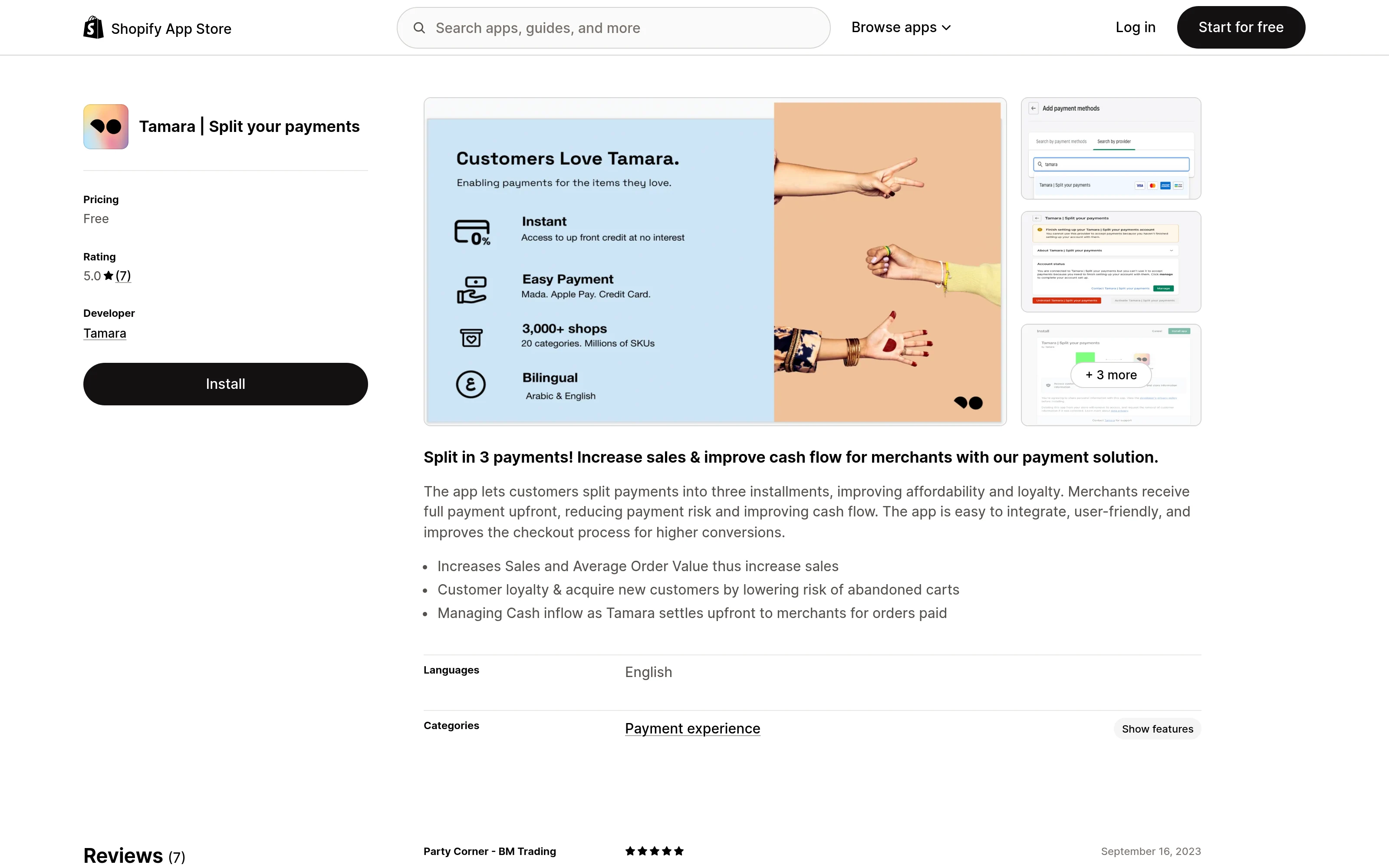
- Shopify support: The Tabby Shopify App Store listing states support for merchants in the UAE and Saudi Arabia (AED and SAR currencies) and allows pay-in-4 and pay-later options at checkout.
- Regional focus: Tabby operates as a BNPL provider in Saudi Arabia, the UAE and Kuwait, and has also been referenced by the UAE Ministry of Finance as a partner for some federal service instalment payments.The Ministry’s November 2025 newsletter notes a partnership enabling instalment payments for some government fees and fines via Tabby.
Tamara integrations and markets
- E-commerce platforms: Tamara lists integrations with Shopify, WooCommerce, Magento, OpenCart and custom integrations via API or plugins.Tamara’s integrations page confirms this.
- Shopify support: The Tamara Shopify app supports merchants in Saudi Arabia, the UAE and Kuwait and offers instalment and pay-later options at checkout.
- Currency coverage: QuickCommerce’s BNPL documentation notes that, via its platform, Tamara can be configured with SAR (Saudi Arabia), AED (UAE), BHD (Bahrain), KWD (Kuwait) and OMR (Oman) as checkout currencies, although this does not in itself confirm current merchant onboarding or regulatory status in each of those countries.The QuickCommerce docs provide that list.
For a UAE merchant planning regional expansion, this additional currency support is one factor to consider. It suggests that Tamara may be able to provide local-currency experiences for shoppers in additional GCC markets when it is live and onboarding merchants there, but live availability and regulatory status still need to be confirmed with Tamara.
Customer experience and plan types
From the shopper’s perspective, both Tabby and Tamara aim to be frictionless, interest-free instalment options for eligible customers.
- Tabby shopper products in the UAE: pay-in-4 and pay-in-30 days.Tabby’s shopper page describes both as interest-free for customers who pay on time.
- Tamara shopper products in the UAE: split purchases into 3 or 4 interest-free payments, or pay-next-month.Tamara’s how-it-works content outlines these plans.
For most merchants, the customer-experience difference between Tabby and Tamara is not about plan types (which are broadly similar) but about brand recognition among the target shoppers:
- In the UAE, Tabby has a very visible presence on major retail sites and on certain government payment pages, which can increase trust for UAE-based shoppers.
- In Saudi Arabia and some neighbouring countries, both brands are visible, and local shoppers may have personal preferences.
This is why many UAE store operators who add a single BNPL provider start with Tabby, then add Tamara later if BNPL adoption is strong and they want to capture incremental customers.
Operational complexity: reconciliation, disputes and support
Operationally, each BNPL provider adds another payment method to reconcile. Main areas to think about:
- Settlement reports: Payout files are issued by Tabby and/or Tamara; the finance team must reconcile these against orders in Shopify, WooCommerce or an ERP.
- Refund flows: Refunds often need to be initiated both in the e-commerce platform and in the BNPL merchant portal or plugin. Incorrect sequencing can delay customer refunds or leave unreconciled balances.
- Chargebacks/disputes: BNPL providers typically handle credit risk and collection, but disputes around delivery, quality or fraud can still involve the merchant. Processes differ by provider and contract.
- Support responsiveness: Independent comparisons such as FlexiCommerce’s guide highlight that merchants should evaluate account management and support responsiveness during onboarding, because payouts and refunds are time-sensitive.
Adding a second BNPL provider (running both Tabby and Tamara) multiplies this complexity. It may be worth it for large brands, but small teams need to be realistic about the finance and operations workload before enabling both.
Fit by product category and margin profile
Whether BNPL makes business sense depends heavily on margin and return profile, not only on which provider is chosen.
Categories where Tabby or Tamara often make sense
- Mid- to high-margin fashion and accessories: 40–60% gross margins can absorb a 3–6% BNPL commission, especially if BNPL lifts AOV.
- Beauty, cosmetics, personal care: Often strong margins and repeat purchases; BNPL can encourage larger baskets.
- Home decor, furniture, appliances: Higher ticket items where instalments meaningfully affect conversion.
In these categories, many merchants start with Tabby due to indicative lower commission ranges, then add Tamara to capture additional customers, especially when selling into markets such as Kuwait or other GCC countries where Tamara is live.
Categories where BNPL can be risky or marginal
- Low-margin electronics accessories or commodity products: If gross margin is 15–25%, a 3–6% BNPL commission plus shipping and marketing can leave little or no profit.
- Very high-return segments (fast fashion, footwear, some electronics): As the earlier scenarios show, refund fee retention can erode profit quickly.
- Subscription or service-based businesses: BNPL is built for one-off purchases with clear delivery, not recurring service milestones. Disputes and operational complexity can outweigh any uplift.
For these categories, the default approach should be to skip BNPL or run a tightly controlled experiment (limited products, strict return terms, clear financial tracking) before scaling.
Practical decision rules: Tabby vs Tamara vs both vs neither
Pulling the analysis together, here are practical decision rules grounded in the cost scenarios, regional coverage and reported behaviour.
When to start with Tabby only
Choosing Tabby as the first and only BNPL provider is usually sensible when:
- The business is a UAE Shopify or WooCommerce store targeting mainly UAE and Saudi shoppers.
- Gross margin is at least 30% and return rates are moderate.
- A single, fast-to-deploy BNPL option with strong local recognition is preferred.
Tabby’s Shopify app explicitly supports UAE and Saudi merchants, and multiple independent guides suggest its commission often falls at the lower end of the UAE BNPL market. With a mid-range 4% commission scenario, BNPL reduced blended margin by roughly 1–1.5 percentage points on total revenue in the modelling above. For many consumer brands, this is a reasonable trade-off for improved conversion and AOV.
When to add Tamara alongside Tabby
Adding Tamara as a second BNPL provider is more appropriate when:
- There is already significant BNPL usage with Tabby (for example, 20–30% of orders).
- The brand is expanding beyond the UAE and Saudi into Kuwait or other GCC markets where Tamara is live.
- The finance team can handle more complex reconciliation and payout flows.
Integrator documentation from QuickCommerce notes that, via its platform, Tamara can be configured for SAR, AED, BHD, KWD and OMR, which aligns with potential expansion to Bahrain, Kuwait and Oman when live. The trade-off is a slightly higher blended BNPL fee – the mixed-provider scenario above raised the margin hit by roughly 0.2–0.3 percentage points of revenue versus Tabby alone.
When Tamara only can make sense
A Tamara-only setup may be worth considering if:
- The primary markets are KSA plus Kuwait, with the UAE as a smaller share.
- The audience is especially familiar with Tamara as a brand.
- A competitive commission is secured through negotiation.
The key is not to assume payment of more just because reported ranges are higher. For a specific merchant, Tamara may offer better commercial terms than Tabby; only direct quotes will show that.
When to apply to both and choose based on offers
If a business is new, has limited trading history or sits in a riskier category, approval and pricing can vary widely. In that case:
- Apply to both Tabby and Tamara in parallel.
- Compare concrete offers: percentage commission, any fixed fees, refund fee rules, settlement timing.
- Run an internal version of the AOV/margin/return modelling using each offer’s numbers.
Independent guides such as FlexiCommerce emphasise that this is the only way to make a rational choice, because there is no public rate card.
When BNPL is a bad idea (or low priority)
BNPL – with Tabby, Tamara or any provider – should be treated as optional when:
- Gross margin is below ~25–30% and BNPL would consume a large share of profit.
- The product category has high return rates and complex logistics.
- Cash flow is tight and same- or next-day settlement is needed.
- The business is subscription-first or milestone-based services.
For these merchants, a more suitable path is often:
- Use standard cards and wallets via a gateway that settles quickly.
- Consider instalment plans from UAE banks (card instalments) for high-ticket items instead of BNPL.
- Focus on improving conversion via UX, trust signals and delivery options before paying 3–6% for BNPL.
What changes the decision
Several factors can flip the Tabby vs Tamara vs both vs neither decision:
- Low margins and high returns: If gross margin is below 25–30% and the business sells high-return items (fashion, footwear, consumer electronics), BNPL commissions in the 3–6% range plus retained fees on refunds can consume most of the profit. In this case, skipping BNPL or running a very limited, tightly measured trial with strict refund terms is worth considering.
- Simple UAE/Saudi focus on Shopify or WooCommerce: If sales are mostly to UAE and Saudi shoppers on these platforms, starting with Tabby only is often the cleanest approach because of its strong local visibility, official plugins and typically lower commission band.
- Regional GCC expansion: When there is already strong BNPL adoption and the goal is to capture incremental customers in Kuwait or other GCC markets, adding Tamara makes sense due to its broader currency support via some integrators and footprint in multiple GCC countries.
- New or higher-risk business: For new or riskier businesses, onboarding and pricing are especially case-by-case. Applying to both providers and comparing concrete offers is essential; one may approve or give more favourable terms while the other does not.
- Cash-flow constraints: If the business depends on same- or next-day settlement to pay suppliers and staff, weekly BNPL settlements can create a funding gap. In that case, negotiating shorter BNPL settlement cycles or deprioritising BNPL in favour of standard gateway payments and bank instalments is advisable.
- Subscription and service-heavy models: For subscription or complex service billing, BNPL adds operational risk without much uplift, so it is usually better avoided.
How to structure BNPL negotiation and rollout
Because pricing is not public, negotiation and rollout planning matter as much as the provider choice.
Step 1: Collect offers in writing
For each provider, request:
- Percentage commission on BNPL orders.
- Any fixed per-transaction fees.
- Exact refund fee policy (how much of the fee is retained on full and partial refunds).
- Settlement schedule and any thresholds for payouts.
- Any volume-based discounts or introductory promotions.
Independent UAE comparisons such as FlexiCommerce strongly recommend getting this documented before signing.
Step 2: Run a margin model
Using actual AOV, gross margin and return rate, build a simple spreadsheet mirroring the scenarios in this article:
- Row for total revenue, number of orders, BNPL share.
- Row for BNPL fees = BNPL orders × AOV × commission.
- Row for refund-related retained fees = refunded BNPL orders × retained fee per order.
- Compare BNPL profit vs non-BNPL profit after fees.
This will show exactly how many percentage points of margin are being traded for BNPL conversion uplift.
Step 3: Start with a restricted rollout
Instead of enabling BNPL for every order immediately, consider:
- Offering BNPL only above a certain cart value (for example, AED 250–300).
- Excluding very high-return product lines from BNPL eligibility if the contract allows.
- Monitoring BNPL share of checkout, AOV lift and return patterns for 2–3 settlement cycles.
The resulting data can then inform whether to keep the provider, renegotiate pricing or adjust return policies.
Comparison criteria
This comparison rests on:
- Official documentation and legal pages from Tabby and Tamara for product definitions, regulatory status, settlement principles and fee structures where published.
- Shopify App Store listings and provider integration pages for platform support and market coverage.
- Independent, UAE-focused BNPL comparisons (for example, Middle East Ecom, FlexiCommerce, TAIF Marketing) for indicative commission ranges, settlement patterns and onboarding prerequisites.
- Normalised cost modelling using those indicative ranges to show how BNPL fees affect margins for a UAE merchant.
No live testing or private contract data is included; all numbers used are either explicitly stated in public documents or clearly labelled as indicative merchant-reported ranges.
FAQ
Which is cheaper for UAE merchants, Tabby or Tamara?
Independent UAE-focused blogs commonly report Tabby commission in the 3–5% range and Tamara in the 4–6% range of order value, but both negotiate per merchant and do not publish official rate cards. For many mid-margin UAE stores, Tabby appears cheaper on paper in these reports, but concrete offers should always be compared because an individual contract could differ from these indicative bands. For deeper Tabby-specific setup details, see Tabby for business: merchant setup, fees & integrations.
How fast do Tabby and Tamara settle payouts to UAE merchants?
Merchant-focused guides based on interviews describe both Tabby and Tamara using weekly settlement cycles, with the specific payout day defined in the merchant contract. Neither provider publishes a detailed UAE settlement SLA publicly, so exact timelines and any thresholds should be confirmed during onboarding.
Do Tabby and Tamara charge merchants fees on refunded orders?
Yes, both providers reserve the right to retain some or all of their fees on refunded orders. Tabby’s publicly available Saudi merchant terms show it retaining a fixed fee plus 2% of the percentage-based fee on refunds, while Tamara’s terms allow fee retention without publishing exact UAE percentages, so UAE merchants should insist on clear written refund fee rules in their contracts. If you lean more towards Tamara because of regional coverage, read the UAE-focused Tamara for business: merchant payments, fees & integrations before you sign.
Should a low-margin UAE merchant offer BNPL at all?
If gross margin is below about 25–30% and the category has high return rates, BNPL commissions in the 3–6% range plus retained fees on refunds can remove a large share of profit. In these cases, BNPL should be treated as optional and only introduced after tight modelling and, ideally, a small, controlled trial.
Is it better to integrate both Tabby and Tamara from day one?
For most small and mid-sized UAE stores, starting with a single BNPL provider, typically Tabby, keeps operations simpler and costs slightly lower while the business learns how BNPL affects customers and returns. Adding Tamara later can make sense once BNPL adoption is strong and the team is ready to manage the extra reconciliation and marginal increase in blended fees.